

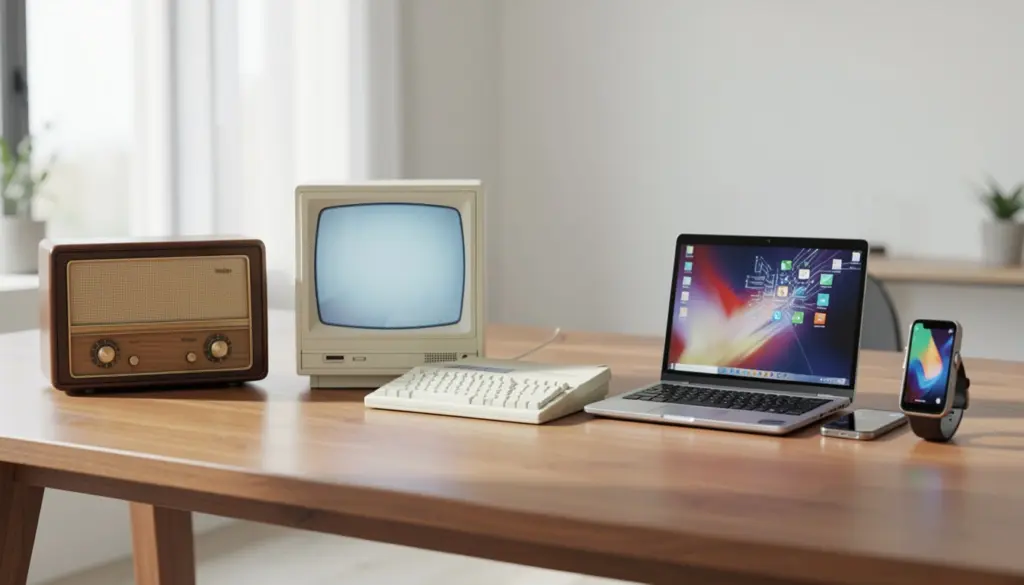
Few forces have reshaped daily life as thoroughly as the progression of consumer technology. The devices people use to communicate, work, entertain themselves, and manage their homes have changed dramatically over the past century — and the pace of that change keeps accelerating.
Understanding the history of consumer electronics isn’t just an academic exercise. It reveals clear patterns: how new materials and engineering breakthroughs create new product categories, how consumer demand pushes manufacturers to refine and miniaturize, and how each generation of devices sets the stage for the next. This article traces that progression from the earliest household electronics to the connected, software-driven devices that define life today.
What Is Consumer Technology?
Consumer technology refers to electronic devices and systems designed for personal, household, or everyday use — as opposed to industrial machinery or enterprise infrastructure. The term covers a wide range: televisions, radios, personal computers, smartphones, digital cameras, wearables, and smart home devices all fall within the consumer electronics industry.
What separates consumer technology from other categories is its orientation toward accessibility and mass adoption. Products are designed to be affordable, easy to use, and broadly appealing. This focus on the end user has historically driven rapid product cycles and intense competition among manufacturers, which in turn accelerates innovation.
Early Consumer Electronics and Household Technology
The foundation of consumer electronics was laid in the early twentieth century, when electricity became a standard feature of homes in industrialized nations. The radio was among the first mass-market electronic devices, bringing news, music, and entertainment into living rooms from the 1920s onward. By mid-century, millions of households across North America and Europe owned a radio set.
Television arrived next and quickly became the dominant household technology of the postwar era. The transition from black-and-white to color broadcasting in the 1950s and 1960s marked one of the first clear examples of an improvement cycle that would repeat throughout technology history: a major quality upgrade that drove consumers to replace working devices with newer models.
Other early household technologies — including electric washing machines, refrigerators, and hi-fi audio systems — showed that consumers were willing to invest in devices that made life easier or more enjoyable. These products established the consumer electronics industry as a serious commercial force and created the retail infrastructure that would later support the sale of computers and smartphones.
The Rise of Personal Computing
Early Home Computers
The transition from large mainframe computers — machines that filled entire rooms and required professional operators — to devices ordinary people could own and use at home is one of the defining turning points in consumer technology history.
Early home computers like the Altair 8800 (1975), the Apple II (1977), and the Commodore 64 (1982) were affordable enough for middle-class households, even if their utility was initially limited. Users had to learn basic programming to do much with them, and software options were sparse. Despite these barriers, adoption was rapid among hobbyists, educators, and small business owners.
The IBM Personal Computer, released in 1981, gave the category its enduring name: the PC. IBM’s decision to build around an open hardware architecture allowed a thriving ecosystem of compatible machines and software to develop rapidly.
The Growth of Personal Software
Hardware alone doesn’t explain why personal computers took hold so quickly. The development of consumer-friendly software — word processors, spreadsheet applications, and eventually graphical operating systems — turned computers from engineering toys into productivity tools with broad appeal.
Microsoft’s MS-DOS and, later, Windows made PC interaction accessible to users with no programming background. Apple’s Macintosh (1984) introduced the graphical interface to a mainstream audience, establishing design principles that still govern operating systems today. The availability of software made the hardware worth buying, and the hardware market in turn funded software development — a cycle that would repeat with smartphones decades later.
How PCs Changed Everyday Life
By the late 1980s and through the 1990s, personal computers had moved from novelty to necessity in many households and workplaces. Tasks that once required specialized services — typing documents, managing finances, storing and retrieving information — became things people handled themselves. The PC also changed how children learned, with educational software introducing a generation to computing from an early age.
Device miniaturization played a growing role during this period. The laptop computer brought portable computing to travelers and students, shrinking what had been a desk-bound machine into something that fit inside a bag. This trend toward portability would accelerate dramatically in subsequent decades.
The Internet and the Digital Revolution
The arrival of the internet as a consumer product in the mid-1990s fundamentally altered what personal technology could do. Email, websites, and online commerce transformed computers from standalone productivity machines into portals connecting users to a global network of information and people.
Broadband connections, which became widely available in the early 2000s, removed one of the biggest barriers to online adoption: the slow speed of dial-up access. With faster connections, streaming media, online gaming, and large file sharing became practical. Consumers began to see their computers not just as work tools but as entertainment platforms.
The internet also reshaped the electronics industry itself. Software could be updated remotely, products could be sold and distributed digitally, and manufacturers could gather detailed data on how their devices were actually being used. This feedback loop shortened product development cycles and allowed companies to refine products in response to real-world behavior rather than relying on pre-launch market research.
Cloud computing extended this digital transformation further. Instead of storing data and running applications locally, users increasingly relied on remote servers — Google Docs instead of Microsoft Word installed on a hard drive, Spotify instead of a physical CD collection. The device in the user’s hand became less important than the services it could access.
Mobile Technology and the Smartphone Era
Mobile phones entered the consumer market in the late 1980s as expensive, status-oriented devices. Through the 1990s, falling prices and expanding network coverage brought basic handsets to a mass audience. By the early 2000s, mobile phones were ubiquitous in most developed markets, and SMS messaging had become a primary form of personal communication.
The smartphone era began in earnest with the launch of Apple’s iPhone in 2007. The device combined a phone, a music player, and an internet browser in a single, touchscreen-driven form factor. More significantly, the App Store model that Apple introduced the following year turned the iPhone into an open platform — a device whose capabilities were defined not just by its hardware but by a vast, continuously growing library of third-party applications.
Google’s Android operating system, released in 2008, made the smartphone model available across a wide range of hardware from dozens of manufacturers, accelerating adoption and driving prices down. Within a decade, smartphones had become the primary computing device for billions of people worldwide — especially in developing markets where desktop PC infrastructure had never fully established itself.
The smartphone’s impact on consumer technology history is difficult to overstate. It collapsed multiple product categories into a single device, reshaped industries from photography to navigation to banking, and introduced always-connected, app-based computing to users who had little prior experience with personal technology. The history of personal technology has a clear before-and-after divided by the smartphone.
The Age of Smart and Connected Devices
The past decade has seen the principles introduced by smartphones — internet connectivity, software-driven functionality, continuous updates — extend to a growing range of household and personal devices. Smart televisions, connected speakers, fitness trackers, thermostats, and security cameras are now standard consumer products in many markets.
Wearable technology represents one of the most significant developments in this period. Smartwatches and fitness bands moved computing to the body, enabling continuous health monitoring and quick access to notifications without requiring users to reach for a phone. The Apple Watch, which launched in 2015, established smartwatches as a mainstream product category and accelerated interest in health-focused consumer devices.
Smart home devices have changed how people interact with their living spaces, and the AI systems embedded in them represent some of the most accessible real-world AI applications in everyday life. Voice-activated assistants like Amazon Echo and Google Home introduced a conversational interface to household technology, allowing users to control lights, thermostats, music, and shopping lists through spoken commands. These devices also illustrated a broader pattern: the shift from devices that respond to deliberate user input toward devices that anticipate needs and operate more autonomously.
The connected device landscape raises important questions about data privacy and cybersecurity that remain central to the ongoing development of this technology. How much personal data should always-on IoT devices collect, and who controls it? These questions don’t have settled answers, but they shape both regulatory discussions and consumer purchasing decisions.
Key Innovations That Accelerated Consumer Technology
Several specific breakthroughs drove the broad arc of consumer technology history:
Microprocessors made it practical to embed computing power in small, affordable devices. The first commercial microprocessor, Intel’s 4004, arrived in 1971. Successive generations became exponentially more capable at lower costs, following the pattern described by Moore’s Law — the observation that transistor density roughly doubles every two years — enabling everything from home computers to smartphones to smart appliances.
Wireless connectivity — from Bluetooth to Wi-Fi to cellular networks and now 5G — removed the physical cables that had tied devices to fixed locations. Wireless standards made portability practical at scale and set the foundation for the connected device ecosystem that exists today.
Cloud computing shifted the architecture of digital services, allowing devices to offload storage and processing to remote servers. A smartphone can run applications and access data far beyond what its hardware could handle independently, because heavy computation happens elsewhere.
Artificial intelligence is now woven into consumer devices in ways that weren’t practical even a decade ago. Voice recognition, camera-based features, and personalized recommendations all rely on machine learning systems running either on the device or in the cloud. Understanding how AI works at a foundational level helps explain why these features have only recently become possible at a consumer scale. AI has become a core component of the consumer technology experience rather than a specialized add-on.
Lithium-ion battery technology deserves mention alongside software and processing innovations. The ability to pack significant energy into a small, rechargeable package made portable electronics practical across a wide range of form factors — from laptops to smartphones to wireless earbuds.
Future Directions in Consumer Technology
Consumer technology continues to evolve along several clear trajectories, and the broader technology trends shaping the next decade — from quantum computing to augmented reality — will determine what consumer products look like beyond current horizons.
Artificial intelligence is moving from a background feature to a front-facing capability, with AI assistants, AI-generated content tools, and AI-driven personalization changing how users interact with their devices.
Augmented and virtual reality technologies, though still in early commercial stages, point toward new form factors beyond the flat screen. Extended reality headsets and glasses aim to blend digital information with the physical world in ways that go well beyond what smartphones or televisions can deliver.
The continued expansion of connected devices — the Internet of Things — means that consumer technology is becoming embedded in more objects and environments. Vehicles, appliances, clothing, and urban infrastructure are all acquiring digital capabilities, extending the concept of consumer technology beyond traditional device categories.
The pattern visible throughout consumer technology history suggests that whatever comes next will follow familiar dynamics: a technical breakthrough reduces cost or expands capability, early adopters test the market, mass production drives prices down, and mainstream adoption reshapes behavior. Understanding that pattern is perhaps the most useful insight this history offers.
FAQs
How did consumer electronics evolve?
Consumer electronics progressed from simple household devices like radios and televisions in the early twentieth century, through personal computers in the 1970s and 1980s, to internet-connected devices in the 1990s, smartphones in the 2000s, and today’s broad ecosystem of smart, connected devices. Each era built on technological advances from the one before it.
What were the first consumer electronic devices?
The radio is widely considered one of the first true consumer electronics products, gaining widespread household adoption in the 1920s. The television followed in the postwar period, along with home audio equipment. These early devices established the consumer electronics industry as a major commercial sector.
When did personal computers become popular?
Personal computers began reaching mainstream households in the late 1970s with models like the Apple II and Commodore 64. Adoption accelerated significantly after the IBM PC launched in 1981 and expanded through the late 1980s and 1990s as prices fell and software became more useful.
How did smartphones change consumer technology?
Smartphones consolidated multiple product categories — phone, camera, music player, navigation device, and computer — into a single, connected device. The app store model turned smartphones into open platforms, enabling constant expansion of capabilities through third-party software. For billions of users, the smartphone became the primary personal computing device.
Why does consumer technology evolve so quickly?
Several factors drive rapid technology cycles: competition among manufacturers, the decreasing cost of components like microprocessors and memory, consumer demand for better performance and new features, and the ability to deliver software updates that continuously change device capabilities. These forces reinforce each other, compressing the time between major innovations.
How has the internet influenced consumer technology?
The internet transformed personal computers from standalone productivity tools into networked devices connected to a global information system. It enabled new categories of digital services, changed how software is distributed and updated, and eventually merged with mobile technology to create the always-connected device landscape that characterizes modern consumer technology.