

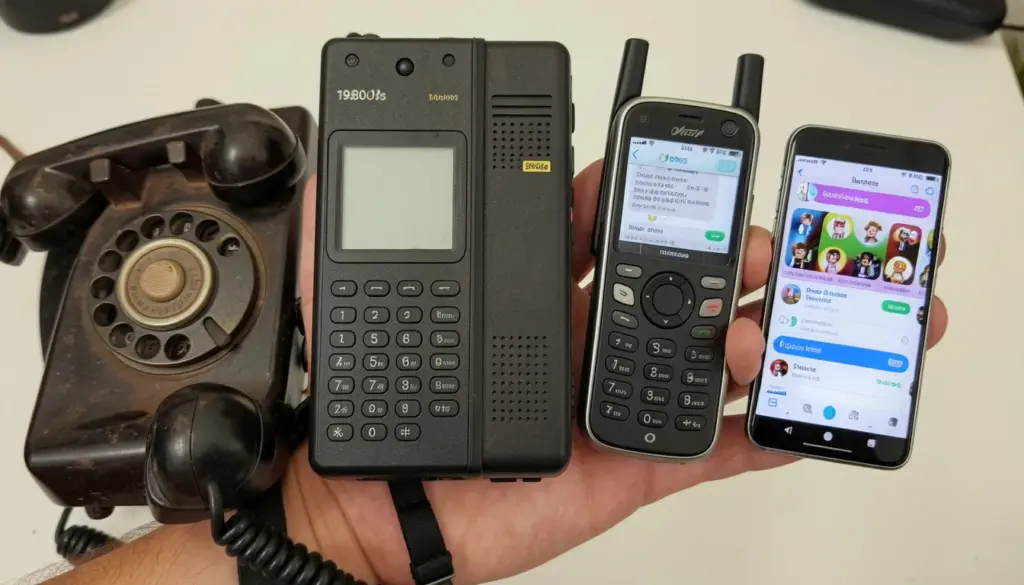
Think about the last time you sent a letter. For most people, that memory is distant — replaced by instant messages, video calls, and notifications that arrive before a thought is fully formed. This shift didn’t happen overnight. It unfolded across decades, driven by a series of technological breakthroughs that quietly rewired the way humans stay in touch.
Mobile technology sits at the center of that story. From the first bulky handheld phones to the pocket-sized computers we carry today, each stage of development didn’t just improve communication — it fundamentally changed what communication looks like. This article traces that journey, explaining what changed, why it mattered, and what it means for how we connect.
Communication Before Mobile Technology
Before mobile phones existed, staying in touch required patience and planning. Landline telephones were fixed to walls and desks, meaning both parties had to be in a specific location at the same time. Miss the call, and there was no voicemail for most of history — just the assumption that you’d try again later.
Written communication meant physical letters that took days or weeks to arrive. Telegrams were faster but expensive and limited to short, formal messages. Long-distance calls were a luxury, often reserved for important news rather than casual conversation.
Geography created real barriers. If someone was traveling, they were effectively unreachable until they returned or found a payphone. Coordination required either careful planning or accepting that plans would sometimes fall apart. The friction built into everyday communication was simply accepted as normal.
The Birth of Mobile Phones (1G Era)
The concept of a portable communication device became reality in the early 1980s with the introduction of first-generation (1G) wireless networks. These were analog systems, meaning they transmitted voice signals in a continuous wave — similar in principle to radio broadcasting.
The devices themselves were large and heavy, often described as “bricks.” Motorola’s DynaTAC 8000X, released in 1983, is one of the most recognizable early examples. It weighed over a kilogram and offered roughly 30 minutes of talk time after a long charge. Owning one was a statement of status as much as utility.
Despite these limitations, 1G networks introduced something genuinely new: the ability to make a phone call without being tied to a physical location. The idea that communication could happen anywhere — not just in offices or homes — was a meaningful shift, even if the reality was still limited by cost, battery life, and patchy coverage. Wireless communication had moved from theoretical to practical.
The Digital Shift (2G and SMS Revolution)
The transition from analog to digital networks in the early 1990s marked a turning point that most people didn’t fully notice at the time, but one that shaped everything that followed. Second-generation (2G) networks carried voice as digital data rather than analog signals, which meant clearer calls, better security, and more efficient use of network capacity.
The more quietly significant development, however, was Short Message Service — SMS. Text messaging was initially designed as a side feature, a technical byproduct of the signaling channels used to manage calls. The first SMS was sent in December 1992 in the UK. For several years, most people barely used it.
Then something changed. Teenagers and young adults discovered that texting was fast, quiet, and cheap — especially compared to calls. By the late 1990s and early 2000s, SMS had grown into a communication channel in its own right. People began using shorthand to stay within character limits, creating a new informal language built for small screens and fast exchanges.
For the first time, written communication became truly instant. A message sent arrived within seconds. This compressed the emotional distance that had always existed in written exchanges — a letter took days, but a text was effectively real-time. The habits formed around SMS messaging would later transfer directly to every messaging app that came after it.
The Rise of Mobile Internet (3G and 4G)
Third-generation (3G) networks, which began rolling out in the early 2000s, brought internet access to mobile phones for the first time at speeds that were actually usable. Email could now be checked from a handset. Basic web pages loaded, albeit slowly. For business users, especially, this was a significant change — being away from a desk no longer meant being cut off from information.
The leap to fourth-generation (4G LTE) networks from around 2010 onward transformed mobile internet from a convenient supplement to a primary communication channel. Streaming video, high-quality audio calls over data, and complex web applications all became practical on mobile devices. The always-connected lifestyle — where a person expects to have internet access anywhere, at any time — became realistic rather than aspirational.
Mobile internet access changed more than just what phones could do. It changed the relationship between users and information. Questions could be answered immediately. Maps replaced asking for directions. News arrived continuously rather than in scheduled broadcasts. The phone became a window onto an entire ecosystem of services, and communication was woven through all of it.
The Smartphone Revolution
When Apple released the iPhone in 2007, and Google followed with Android in 2008, they weren’t just releasing new devices — they were redefining what a phone was for. Touchscreen technology removed physical keyboards and created an interface that felt more direct and intuitive. The screen became the entire device, and the device became a platform.
Smartphones combined everything that had developed separately — voice calls, SMS, mobile internet, cameras, and portable computing — into a single object that fit in a pocket. More importantly, they made all of these capabilities accessible to ordinary users without technical knowledge.
The Role of Mobile Apps in Communication
The launch of dedicated app stores in 2008 opened the door to a different kind of communication infrastructure. Developers could now build services that ran directly on a user’s phone and were always available. Communication apps were among the first and most widely adopted.
Messaging apps like WhatsApp, launched in 2009, offered something SMS couldn’t: free messaging over the internet, with no per-message cost and no character limit. Video calling became practical through apps like Skype, and later FaceTime, and many others. Voice over Internet Protocol (VoIP) — using internet data for voice calls — moved from a business tool into everyday use.
Social media platforms arrived on mobile and reshaped social interaction. Facebook, Twitter, Instagram, and others built their mobile apps into communication tools as much as content platforms. Sharing moments, responding to events, and maintaining relationships increasingly happened through these apps rather than through calls or face-to-face contact.
The app ecosystem turned smartphones into communication hubs, where users could maintain dozens of different channels — work email, personal messaging, group chats, social feeds — from the same device, switching between them fluidly throughout the day.
Evolution of Messaging: From SMS to Instant Messaging Apps
The path from SMS to modern messaging apps is one of the clearest examples of how mobile technology drives behavioral change. Early texting was constrained — 160 characters, text only, per-message charges. Users adapted, abbreviating and compressing meaning into short bursts. Those habits became the foundation for how people communicate in digital text today.
Multimedia Messaging Service (MMS) extended SMS to include images and short video clips, adding a visual layer to mobile messaging for the first time. But MMS had its own limitations, and it was the arrival of internet-based messaging apps that truly changed the picture.
Apps like WhatsApp, iMessage, Telegram, and later Snapchat and others offered features that fundamentally changed expectations: delivery receipts, read indicators, typing notifications, voice messages, video calls, group chats with dozens of participants, and file sharing — all in a single conversation thread. Communication became richer and more immediate.
Video calling deserves particular attention. The ability to see the person you’re speaking with, at no cost, from anywhere in the world, is something that would have seemed extraordinary just a generation ago. It has changed how families maintain connection across distances, how colleagues collaborate remotely, and how relationships of all kinds are sustained through separation.
Real-time messaging has also shifted expectations around availability. The norms that once surrounded phone calls — calling at certain hours, waiting for someone to pick up — have been replaced by an assumed constant accessibility that brings both benefits and pressures.
How Mobile Technology Transformed Communication
Taken together, the changes across each era of mobile technology amount to something more than an improvement in speed or convenience. They represent a reorganization of how people relate to communication itself.
- Speed is the most obvious change. Information that once took days now takes seconds. Decisions that required waiting for a response can now be made in real time. Coordination across time zones has become routine rather than complicated.
- Global connectivity is the second major shift. A person in one country can maintain daily contact with someone on the opposite side of the world at effectively no cost. Communities that would previously have been separated by geography can now exist and communicate without that barrier.
- Social behavior has been reshaped in ways that are still being understood. Mobile communication made it normal to be in contact with many people simultaneously, across multiple channels, throughout the day. The social circle — once defined by physical proximity — became fluid and extended. Relationships with people far away can feel as present as those with nearby neighbors.
Communication also became more documented. Conversations that would once have been spoken and forgotten now exist as text records. This has changed how people think about what they say and how they say it, for better and worse.
The shift from voice to text as the dominant mode of daily communication is particularly significant. Where a phone call once required full attention and real-time response, a text message can be sent and read on each person’s own schedule. This asynchronous communication model has become the default for many relationships, reshaping the rhythm of everyday interaction.
The Future of Mobile Communication
Fifth-generation (5G) networks represent the current frontier of mobile connectivity. Where 4G made mobile internet fast enough for most purposes, 5G pushes speeds and reduces latency to levels that enable new categories of application — from high-resolution video in crowded spaces to the communication infrastructure needed for autonomous systems and connected devices at scale.
Beyond pure network speed, artificial intelligence is beginning to shape how communication happens. Smart reply suggestions, translation tools that work in real time, and voice assistants that handle routine communication tasks are already common. As these tools improve, the boundary between human communication and AI assistance will continue to shift.
Emerging technologies like augmented and virtual reality are likely to add new dimensions to mobile communication over time — creating experiences that are richer than video calls but don’t require physical presence. The direction is toward communication that feels more immersive and immediate, even across distance.
What remains consistent across every generation of this technology is the underlying motivation: people want to stay connected, share information, and maintain relationships. Mobile technology has repeatedly found new ways to serve that need, and each advance has changed not just how people communicate, but what they expect communication to feel like.
FAQs
What is the difference between 1G, 2G, 3G, 4G, and 5G?
Each generation represents a major upgrade in wireless network technology. 1G was analog and voice-only. 2G introduced digital voice and SMS. 3G added usable mobile internet. 4G LTE-enabled fast mobile broadband, streaming, and complex apps. 5G delivers significantly higher speeds and lower response times, enabling new applications across industries.
How did texting change communication?
SMS gave people a fast, low-cost, asynchronous alternative to phone calls. It normalized written digital communication, established new informal language conventions, and laid the behavioral foundation for every messaging app that followed. Texting also shifted when and how people expected responses, creating a more flexible rhythm to daily communication.
What role did apps play in mobile communication history?
Mobile apps were a turning point because they created communication services that operated independently of traditional telephone infrastructure. Messaging apps, social media platforms, and VoIP tools gave users free, feature-rich communication channels and introduced capabilities — like group video calls and multimedia sharing — that SMS never offered.
How has mobile technology affected social relationships?
It has made distance less of a barrier to maintaining relationships, enabled contact with large numbers of people simultaneously, and shifted communication toward text-based exchanges. It has also raised expectations around availability and response time, which has changed the social dynamics of being reachable.