

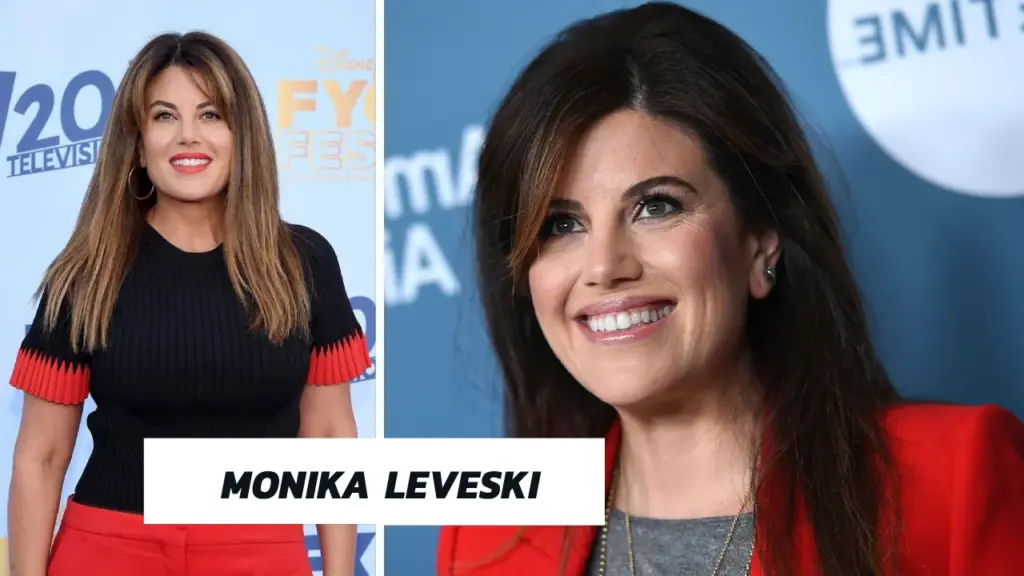
You searched for “Monika Leveski” and landed here. That’s worth explaining before anything else — because this name, as it appears across dozens of websites in 2026, is largely a fiction.
Every article ranking for this query follows the same pattern: sweeping claims about a “visionary artist” or “corporate leader” with no verifiable credentials, no real institutions, and no dated achievements. Some pages describe her as a mixed-media painter. Others say she holds a Cambridge Ph.D. in educational technology. One site connects the name directly to Monica Lewinsky. That last one is closest to the truth.
This article does two things: it explains why the search term exists and who it actually leads to, and it tells the real, documented story of Monica Lewinsky — a person whose life is genuinely worth knowing about.
Why “Monika Leveski” Leads You Here
The name appears to be a phonetic misspelling of Monica Lewinsky — close enough that some searches and autocomplete queries produce results for both. Lewinsky’s surname, with its Slavic-origin suffix, is frequently misspelled in casual searches, and content farms have capitalized on that traffic gap by publishing AI-generated biography pages for the misspelled name.
These pages rank not because they contain real information, but because they fill a vacuum. They use the same generic phrases — “humble beginnings,” “vibrant artistry,” “resilience and determination” — recycled across dozens of fake profiles for fabricated people. If you came looking for facts, you were not going to find them there.
So let’s set the record straight.
Who Is Monica Lewinsky? A Real Biography
Monica Lewinsky is an American activist, public speaker, writer, and producer. At 52 years old, she is one of the most recognizable figures in modern discussions of online harassment, public shaming, and personal reinvention.
Early Life and Education
Lewinsky was born in San Francisco, California, and grew up in an affluent family in Los Angeles. She attended Lewis & Clark College in Portland, Oregon, graduating with a bachelor’s degree in psychology in 1995. Later, she pursued graduate studies abroad, obtaining a master’s degree in psychology from the London School of Economics in 2006. Her master’s thesis, notably, focused on pre-trial publicity and impartial jury selection — a subject that reflected her own experience of being tried in the court of public opinion.
The Scandal That Changed Everything
With the assistance of a family connection, Lewinsky secured an unpaid summer White House internship in the office of White House chief of staff Leon Panetta in July 1995. She moved to a paid posting in the White House Office of Legislative Affairs in December 1995.
Over the following two years, she developed a relationship with President Bill Clinton. In April 1996, Lewinsky’s superiors transferred her from the White House to the Pentagon because they felt she was spending too much time with Clinton. The situation escalated when a coworker, Linda Tripp, secretly recorded phone conversations about the relationship and turned them over to independent counsel Kenneth Starr.
Starr was permitted to expand the scope of his investigation and used the Tripp tapes as evidence that Clinton had committed perjury in denying under oath any relationship with Lewinsky. The House of Representatives impeached Clinton on charges of perjury and obstruction of justice; he was acquitted by the Senate in 1999.
Lewinsky, then 24 years old, found herself the subject of global ridicule almost overnight — without the ability to respond publicly, without legal protection from the media onslaught, and without precedent for what she was experiencing.
The Years of Silence and Rebuilding
The years immediately following the scandal were grueling. Facing legal fees from her representation in the Clinton impeachment hearings, Lewinsky gave interviews, sold the rights to her life story, and in 1999 created The Real Monica, Inc., a line of designer handbags. She appeared on television, served briefly as a spokesperson, and tried to find a foothold in public life.
It didn’t hold. The media’s appetite for ridicule was relentless, and Lewinsky eventually left the United States. In 2006, she earned a master’s degree in social psychology from the London School of Economics, but continued to struggle finding work due to her notoriety.
For nearly a decade, she largely disappeared from public view. That silence, she has since said, was both survival and preparation.
Reclaiming the Narrative: Advocacy and Public Work
In 2014, Monica Lewinsky stepped back into public life — on her own terms, with a specific purpose.
She returned to the public eye with an essay for Vanity Fair titled “Shame and Survival,” a critique of the culture that humiliated and shamed her. The following year, she gave a TED talk on internet harassment and became a strategic advisor for Bystander Revolution, an anti-bullying organization.
“The Price of Shame” TED Talk
Her 2015 TED talk, “The Price of Shame” — in which she calls herself “patient zero of losing a personal reputation on a global scale almost instantaneously” and advocates for the end of “public shaming as a blood sport” — has garnered more than 20 million views.
The talk did something unusual: it asked the audience not to pity her, but to look honestly at their own participation in online humiliation culture. She named what she had experienced not as a personal failing but as a systemic problem — one that had grown exponentially deadlier with social media.
The TED Talk received a standing ovation at the Global TED Annual Meeting in Vancouver and is now in the top ten of most-viewed TED Talks of all time.
Anti-Bullying Campaigns
Lewinsky did not stop at speaking. She built a body of concrete work. She has built on her viral TED talk to create a growing body of work, activism, and advocacy aimed at forcing us to reconcile with our online behavior, both as individuals and as a collective society.
Her campaigns became progressively more creative. In 2017, she produced “In Real Life,” an Emmy-nominated PSA that visualized common online behaviors in analog form. In 2018, she launched #DefyTheName, calling for people to change their social media usernames to the names with which they had been bullied. Lewinsky herself changed hers to a long list of slurs she had been called publicly since 1998.
In 2019, she released “The Epidemic” — a PSA that depicted cyberbullying as a physical illness affecting a teenage girl. The PSA supported organizations, including the Amanda Todd Legacy, the Crisis Text Line, Sandy Hook Promise, and the Tyler Clementi Foundation.
Today, Lewinsky works with several anti-bullying organizations as an ambassador to both the Diana Award’s Anti-Bullying Programme in the UK and Bystander Revolution in the US. She also sits on the board of the Childhood Resilience Foundation.
Monica Lewinsky in 2025 and 2026
Lewinsky remains active and visible. In February 2025, she launched her podcast, Reclaiming with Monica Lewinsky.
In recent years, she has led several award-recognized anti-bullying initiatives, including 2023’s “Stand Up to Yourself,” which addressed the mental health effects of self-directed bullying.
She served as the keynote speaker at the 2026 Power of Women: Reclaiming Our Story conference in Lincoln, Rhode Island, an annual gathering focused on empowerment, advocacy, and storytelling. Organizers described her as a woman who has reclaimed her narrative and built a legacy centered on community leadership.
At 52, she is not the person the tabloids defined in 1998. She is, by any honest measure, one of the more consequential voices in the ongoing conversation about what online culture does to real human beings.
Why the AI Content Farms Got It Wrong
Here’s the honest context for anyone who ended up on one of those “Monika Leveski” biography pages before finding this one.
The SERP for this query is dominated by content generated by AI tools and published on low-quality websites to capture misspelling traffic. These pages share several telltale signs: they were all published within a few months of each other (late 2025 to early 2026), they use nearly identical sentence patterns, their claims are mutually contradictory, and not one of them cites a single verifiable source, institution, publication, or date.
This is a growing problem in the 2026 search. When a name generates any volume of queries — whether through a misspelling, a trending reference, or a name-generator — content farms publish AI-written biography pages to capture that traffic. The result is a SERP full of confident-sounding fiction.
The practical takeaway: if you search for a person and every result was published in the same 60-day window, uses identical vague language, and cannot point to a single real-world source, you are almost certainly looking at fabricated content.
The real person behind this search has a documented life, a documented impact, and a documented message. That story is worth more than any AI-generated placeholder.
FAQs
Is “Monika Leveski” a real person?
No verified public figure by this name exists. The name appears to be a phonetic misspelling of Monica Lewinsky, and the search term has been used by content farms to publish AI-generated biography pages. None of those pages contains verifiable facts.
Who is Monica Lewinsky?
Monica Lewinsky is an American activist, public speaker, writer, and producer, born July 23, 1973. She became internationally known in 1998 following the Clinton-Lewinsky scandal and has since reinvented herself as a leading voice against cyberbullying and online public shaming.
What did Monica Lewinsky study?
She holds a bachelor’s degree in psychology from Lewis & Clark College (1995) and a master’s degree in social psychology from the London School of Economics (2006), where her thesis examined pre-trial publicity and jury impartiality.
What is Monica Lewinsky doing now?
She hosts the podcast Reclaiming with Monica Lewinsky, continues her anti-bullying advocacy work, serves on the board of the Childhood Resilience Foundation, and speaks globally on topics including online harassment, digital reputation, and resilience.
What is Monica Lewinsky’s most famous speech?
Her 2015 TED Talk, “The Price of Shame,” in which she describes herself as “patient zero” of online public humiliation, has been viewed over 20 million times and ranks among the most-watched TED Talks of all time.
How did Monica Lewinsky become an activist?
After years away from public life, she returned in 2014 with a Vanity Fair essay about her experience of public shaming. She recognized that what she had endured in 1998 — internet-amplified humiliation — had become a daily reality for millions of people, particularly young people, and decided to use her experience to build awareness and change.