

Darin Olien is many things — a wellness researcher, a New York Times bestselling author, an executive producer of Netflix’s Down to Earth with Zac Efron, and a longtime resident of the Malibu Mountains. But among people who follow his work closely, his home is just as much a statement as his books or podcasts.
The story of the Darin Olien house is not the story of a celebrity mansion. It is the story of a man who lost everything to wildfire, chose to stay on his land anyway, lived in a yurt for years while rebuilding with radical intention, and ultimately designed one of the most unconventional non-toxic homes currently under development in Southern California.
This article covers every chapter of that story — the original home, the Woolsey Fire, life in a Pacific Yurt, the Binishell rebuild plan, and what the completed property is designed to look and function like.
Who Is Darin Olien?
Before understanding the philosophy behind his home, it helps to understand the man. Darin Olien built his career around a central belief: that modern life is filled with convenient products and systems that quietly damage human health and the environment. He coined the term “Fatal Conveniences” to describe these trade-offs — synthetic chemicals in personal care products, processed ingredients in food, invisible electromagnetic pollution in buildings.
His book SuperLife became a New York Times bestseller. His follow-up, Fatal Conveniences, expanded that philosophy into everyday consumer choices. His Netflix series introduced these ideas to over 300 million households worldwide.
His home was always meant to be a physical proof of concept for everything he preaches.
The Original Darin Olien House in Malibu
Darin’s original home sat on approximately 50 acres of wild land in the Malibu Mountains. It was not an opulent property. By most accounts, it was a modestly sized, 1950s-era structure — practical rather than palatial — surrounded by nature and positioned far from the density of city living.
The land itself was the real asset. Fifty acres of undeveloped California landscape gave Olien space to grow food, connect with the outdoors, and live at a remove from the systems he had spent his career questioning.
He owned motorcycles, equipment, barns, and outbuildings on the property. The home contained years of accumulated possessions — personal items, research materials, supplements, gear from global travels. It was, in every sense, the headquarters of his life’s work.
The 2018 Woolsey Fire: Losing Everything
In November 2018, Darin Olien was in the Amazon jungle filming the final episode of Down to Earth. He had no cell reception. When the crew returned to civilization, he was greeted with over 100 messages.
A neighbor had photographed his entire property. The home, the barns, the motorcycles, the trucks, the equipment — everything had burned to the ground.
The fire that destroyed his house was later traced to a power pole maintained by Southern California Edison that was not properly kept up. The Woolsey Fire, one of the most destructive wildfires in California history, tore through the Santa Monica Mountains and Malibu hills, burning more than 96,000 acres and destroying nearly 1,600 structures.
While filming the final episode of Down to Earth in 2018, Darin learned his Malibu home had been destroyed in a fire started by a poorly maintained Edison power pole. Only the property’s swimming pool survived intact.
For Olien, it was not just the loss of material things. It was the loss of years of work, of a carefully constructed sanctuary, of a place that embodied his values. He spoke openly about the emotional weight of the experience and the clarity it brought.
He did not move away. He stayed on the land.
Life in a Yurt: Darin Olien’s Interim Home
Rather than relocate to a conventional house or apartment while rebuilding, Olien chose to set up a Pacific Yurt on the same land where his home had stood.
A yurt is a circular, portable structure with a lattice wall frame and a fabric-covered roof. Pacific Yurts, based in Oregon, manufactures modern versions of these structures using architectural-grade materials — high-strength fabric, dome skylights, and engineered wall systems that provide insulation and weather resistance.
The yurt was off the grid and fully solar-powered. Olien lived there with his German Shepherds, looking out at the pool that had survived the fire and at the land where his new house would eventually rise.
The yurt had a bedroom, bathroom, and kitchen — basic but functional. He customized the interior with natural materials, kept only what he genuinely needed, and used the experience as a kind of long-form study in intentional minimalism.
He would go on to spend more than two years living in the yurt before the new building project began to take shape.
The Philosophy Behind the Rebuild: “Fatal Convenience-Free” Living
When Darin Olien decided to rebuild, he was not simply replacing what was lost. He was designing an experiment in what a truly non-toxic, health-conscious home could look like.
He described the goal as building a “fatal convenience-free” home — a structure that would eliminate the very hazards he had spent years warning his audience about. That meant no volatile organic compounds (VOCs) from synthetic paints, adhesives, or flooring. No electromagnetic field (EMF) pollution from poorly designed wiring or wireless infrastructure. Clean, filtered water systems. Clean energy from renewable sources, with no dependence on the grid.
The 50-acre property in the Malibu Mountains was rebuilt after the 2018 wildfire into a living proof of concept for clean, non-toxic living — no EMF, no VOCs, clean power and water systems, described as a sanctuary, not just a home.
The property was later given the name Starlight Permaculture, reflecting a broader vision of ecological regeneration — not just building a healthy house, but restoring the surrounding land to a productive, biologically rich state.
The Binishell: Darin Olien’s New House Design
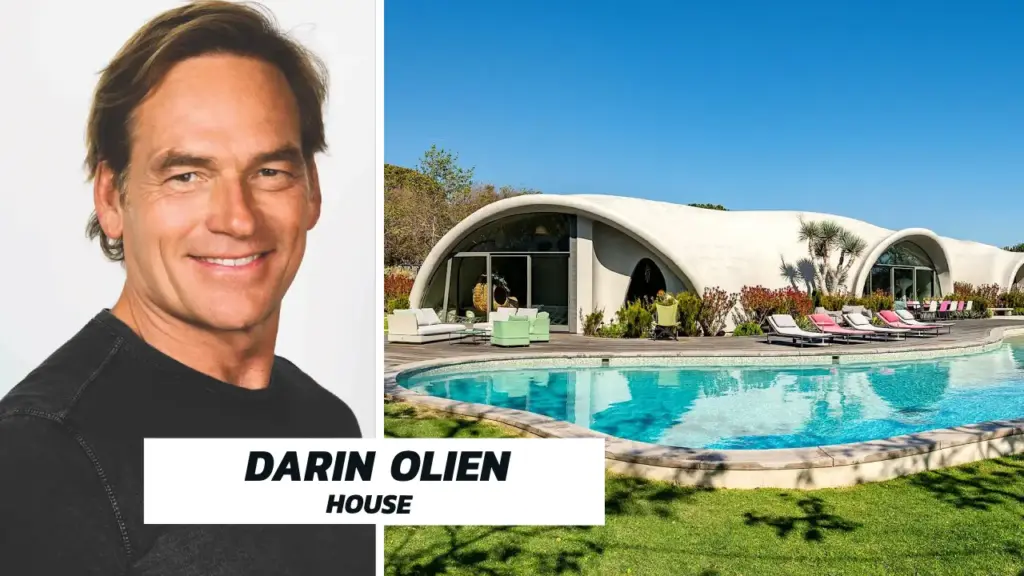
The most distinctive element of the Darin Olien house rebuild is the structure he chose for his new home: a Binishell.
Binishells are dome-shaped structures built using an inflation-based concrete construction technique originally developed in the 1960s by Italian architect Dante Bini. His son, Nicolo Bini, relaunched the technology in 2009 and has since built structures for clients, including Robert Downey Jr. in Malibu.
Binishells are made by inflating a gigantic neoprene bladder with air, then covering it in a thin coat of reinforced spray-on concrete. The result is a smooth, organic dome shape — aerodynamic, structurally sound, and, critically for a Malibu property, highly fire-resistant.
The aerodynamic profile of a Binishell is not just aesthetically striking. In wildfire conditions, the dome shape causes flames to move around and over the structure rather than catching on flat surfaces or sharp corners. The reinforced concrete shell is non-combustible. There is nothing for fire to grab.
Nicolo Bini described the design philosophy simply: “Instead of forcing the ground to accommodate the house, the house accommodates the landscape.”
For Olien’s Malibu property specifically, the structure was designed to operate fully off the grid, with no reliance on fossil fuels. Bini also served as the interior architect — a first for the Binishell construction company.
Beyond fire, Binishells are designed to perform well in earthquakes, floods, and high winds — precisely the kinds of climate stresses that the California coast faces with increasing regularity.
Spring 2025: The First Clean-Built Guest House
The full rebuild of Darin Olien’s Malibu property is a multi-structure, multi-phase project. Rather than rushing to complete a single large building, he took a methodical approach.
Spring 2025 marks the completion of his first clean-built guest house: no EMF, no VOCs, clean power and water systems.
This guest house — the same yurt structure where Olien lived for years after the fire — has been formally completed as the first structure on the property to meet his full set of construction standards. It serves as both a functional building and a demonstration of what the rest of the property will eventually look like.
The main residence, the Binishell dome home, continues as the larger ongoing project under the Starlight Permaculture designation.
What Makes the Darin Olien House Different
Most celebrity homes are evaluated on square footage, architectural style, and market value. The Darin Olien house is evaluated on entirely different metrics.
Non-toxic materials throughout. Every finish, adhesive, coating, and material in the build is selected for its absence of volatile organic compounds. This is not a marketing distinction — VOCs off-gas from standard construction materials for years, affecting indoor air quality in ways that are difficult to measure and easy to ignore.
No EMF design. Electromagnetic field exposure from standard electrical wiring, smart devices, and wireless systems is a growing area of health research. Olien’s build uses wiring configurations and shielding choices that minimize this exposure throughout the structure.
Clean water systems. The property uses filtration and purification systems rather than relying on municipal water sources or unfiltered well water.
Off-grid energy. Solar power, with no dependency on utility-supplied electricity, eliminates both the environmental cost of grid energy and the vulnerability of being connected to aging infrastructure — the same infrastructure that started the fire that destroyed his first home.
Fire-resistant architecture. The Binishell dome structure is non-combustible and aerodynamically shaped to let fire pass around it. After losing a home to wildfire, Olien made this a non-negotiable element of the design.
Permaculture land use. The 50-acre property is managed not just as a residential plot but as a living ecological system — to restore the land to biological productivity rather than maintain it as a manicured backdrop.
Location: The Malibu Mountains
The Darin Olien house is located in the Malibu Mountains — the range of hills that runs inland from the Pacific Coast, forming the boundary between the Los Angeles Basin and the Conejo and San Fernando Valleys.
This is not the beachfront Malibu of celebrity tabloids. It is wilder, quieter, and less traveled. The terrain is steep chaparral and oak woodland, prone to drought, wind, and fire, but extraordinary in its natural character.
Olien has described the land itself as one of his primary reasons for staying after the Woolsey Fire. The connection to that specific place — its views, its wildness, its 50 acres of undisturbed hillside — was not something he was willing to walk away from.
The address is listed generally within Malibu, CA 90265, set well back from the Pacific Coast Highway and removed from the residential density of the canyon neighborhoods closer to the beach.
Darin Olien’s Broader Vision for the Property
The Starlight Permaculture designation is not just branding. It reflects a concrete program of land stewardship that Olien describes as the true long-term project — one that the buildings serve rather than define.
Permaculture is a design system for human settlements and agriculture that works with natural processes rather than against them. On a 50-acre California hillside, this means managing the land for water retention, native plant restoration, food production, and fire resilience simultaneously.
The goal is a property where the house is the least interesting element — where the soil, the water cycles, the food systems, and the biological community of the land tell the more important story.
This aligns directly with Olien’s public work, which has always argued that human health and environmental health are not separate concerns. The Starlight Permaculture property is, in his framing, simply what that argument looks like when you build it instead of just writing about it.
How the Darin Olien House Reflects His Life’s Work
There is a coherence to the Darin Olien house that is worth acknowledging. A man who spent his career warning people about hidden toxins in everyday products, who wrote a book called Fatal Conveniences, who hosted a Netflix series exploring sustainable communities around the world — that man lost his home to an electrical fire caused by neglected infrastructure and responded by building the most infrastructure-independent, toxin-free dwelling he could design.
The yurt years were not a setback. They were researching. The Binishell rebuild is not a vanity project. It is a field test.
Whether the completed Starlight Permaculture property becomes a model that others follow or remains a personal experiment on a Malibu hillside, it represents one of the more coherent attempts by any public figure to actually live inside the values they promote.
Conclusion
The story of the Darin Olien house is about loss, conviction, and the slow, deliberate work of building something better from the ground up. From the original 1950s structure on 50 wild acres, to the years spent in a solar-powered Pacific Yurt, to the off-grid Binishell dome taking shape under the Starlight Permaculture project, every chapter of this property’s history reflects the same underlying question Olien has always asked: what does it actually look like to live in alignment with what you believe?
The first clean-built guest house, completed in spring 2025, marks a significant milestone. The main Binishell structure continues. The land is being restored. And the Darin Olien house is gradually becoming exactly what he said it would be — not a showcase of wealth or style, but a working demonstration that healthier, more resilient, more intentional living is buildable.