

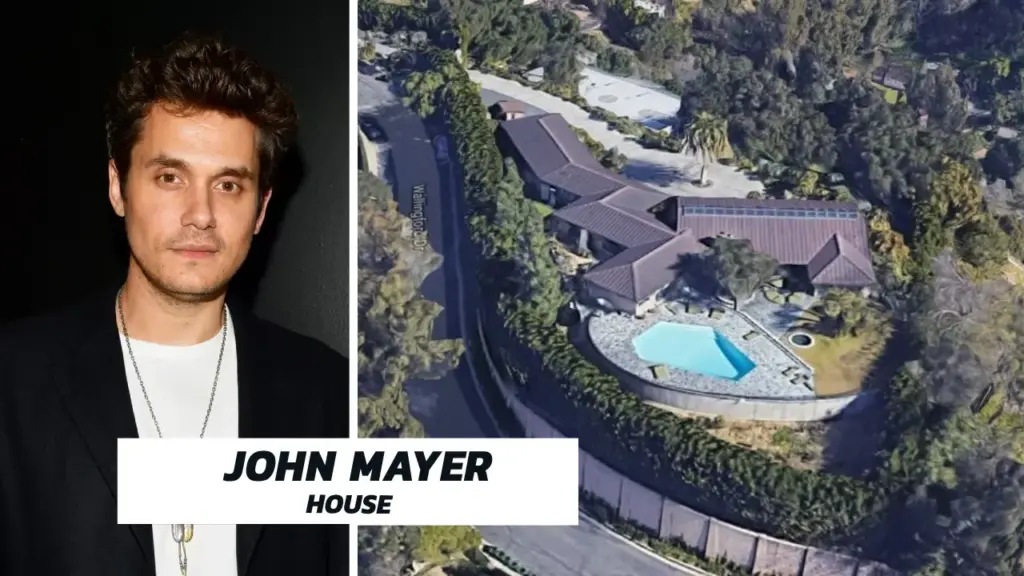
John Mayer has spent much of his adult life on stage, but the homes he keeps reveal a side of him that rarely makes the headlines. While millions know him as the guitarist behind Continuum and Sob Rock, fewer know where he actually lives — and what those properties say about how he spends his time away from the spotlight. This article covers both of John Mayer’s primary residences in detail: his primary home in Beverly Hills, California, and his off-grid retreat in Livingston, Montana.
John Mayer’s Beverly Hills Home: Mid-Century Modern in Benedict Canyon
Location and Purchase
John Mayer’s main residence sits within Wallingford Estates, a gated enclave tucked into Beverly Crest, the section of Los Angeles commonly known as Benedict Canyon. The address places him in one of the most private pockets of Beverly Hills — a neighborhood that has historically attracted serious collectors, musicians, and actors who prioritize seclusion over visibility.
He purchased the property in May 2018 from Adam Levine, frontman of Maroon 5, for approximately $13.4 to $13.5 million. The home had originally been listed at $17.5 million, meaning Mayer acquired it at a meaningful discount. The sale drew attention partly because of the seller, but the property itself is what keeps people interested.
Property Specs
The house is a single-story, mid-century modern ranch with 7,100 square feet of living space spread across five bedrooms and seven bathrooms. It sits on 3.66 acres, which is generous for Beverly Hills, and the elevation gives the property panoramic views of the Los Angeles canyons below.
It is not a towering, glass-and-steel spectacle. The architecture is grounded and horizontal, with exposed beam ceilings, a soaring stone fireplace, and floor-to-ceiling sliding glass doors that draw the outdoors in. The style feels intentional rather than showy — which is consistent with how Mayer has spoken about wanting spaces that feel lived in.
Interior Features
Inside, the home reads as a serious collector’s residence rather than a decorator’s showroom. The gourmet kitchen is built for use, not display. The living and great rooms create an easy flow for entertaining without sacrificing a sense of intimacy. The home theater brings a proper cinematic setup into the property.
There is also a dedicated media room, a fully equipped gym, and a spa — all integrated into the layout in a way that avoids the cluttered feel of a hotel amenity list squeezed into a private home. The two-story car garage with a private elevator is particularly notable for someone with a well-documented passion for collecting vehicles.
Most significantly for Mayer’s career: the property includes a professional-grade music studio. For a working musician who records continuously between tours, having a studio on-site at his primary residence is not a luxury — it is an operational decision.
Outdoor Space and Grounds
The 3.66-acre lot gives Mayer outdoor space that is rare at this price point in Los Angeles. The landscaping is lush and intentional, with mature plantings that create a sense of deep privacy from the street. The custom swimming pool looks out over the canyon, making it one of the more architecturally satisfying features on the property. A basketball court and tennis court round out the recreational amenities.
The gated entrance means arrival to the home is itself a distinct experience — a winding approach through landscape before reaching the main structure.
The 2018 Burglary
Shortly after Mayer moved into the property, the home was broken into. The burglars made off with musical equipment and personal items. The incident prompted Mayer to significantly upgrade the property’s security infrastructure. It is a reminder that even within a gated community, high-profile residents in Los Angeles face real security challenges — and that visible collections, whether watches or guitars, carry inherent risk.
About Benedict Canyon
Benedict Canyon has attracted notable residents for generations. Fred Astaire, Cary Grant, and Jimi Hendrix have all lived in the area at various points in history. The Benedict Canyon Association, founded in 1948, has maintained strict residential zoning throughout, which means the neighborhood has stayed exactly what it was designed to be: quiet, private, and exclusively residential.
The canyon’s vegetation — oaks, chaparral, native grasses — gives it a feel that is closer to rural California than to the city. From inside the house, Los Angeles can feel very far away.
John Mayer’s Montana House: A 15-Acre Retreat on the Yellowstone River
How He Found Livingston
The Montana chapter of Mayer’s life did not begin with a real estate search. In his own words, it began at a hotel bar in Salt Lake City in 2010, where a stranger told him that Livingston, Montana, was the most beautiful town in the world. He kept googling it. A year later, after vocal cord surgery left him unable to sing or tour, he moved.
He has described the decision plainly: it saved his life. Montana pulled him out of what he called a “perceived war” — a state of constant noise and reactive living — and gave him what Los Angeles never could: genuine stillness.
The Property
Mayer’s Montana property covers 15 acres in Paradise Valley, a stretch of land running south of Livingston along the Yellowstone River, roughly an hour north of Yellowstone National Park. The estate is registered through his HMF Montana, LLC.
The main structure is a log-and-stone cabin built in the spirit of 1970s Montana architecture. It is not a modern showpiece. It has wooden beams, stone fireplaces, large windows, and an interior that is warm rather than grand. The design makes sense against the landscape — cottonwood trees, open fields, deer grazing along the riverbank.
The Recording Studio Barn
The most important structure on the property is not the main house. It is the barn.
Mayer converted an approximately 1,800-square-foot barn into a fully acoustically treated recording studio. The acoustic design work was handled by Kaufman & Associates, specialists in professional recording environments. The result is a workspace that functions at the same level as commercial studios — but without the schedule, the commute, or the interruptions.
He has used this space to write and record consistently between tours. During the Sob Rock cycle and in subsequent creative periods, the Montana studio has been his primary production environment. The barn sits apart from the main house, which matters practically: it is a physical separation between living and working.
Off-Grid Infrastructure
The Montana property operates independently of municipal utilities. Solar panels power the estate, and a private well supplies water. Backup systems handle heat and electricity during Montana’s severe winters. This setup is not an aesthetic choice — it is a practical one. The property is remote enough that conventional utility infrastructure would be unreliable, and for someone who records music continuously, reliable power is non-negotiable.
Life in Livingston
Livingston’s population sits around 8,000 people. There are no paparazzi, no tour buses, and no celebrity economy built around its residents. Mayer has described shopping at the local grocery store and going to the neighborhood steakhouse without drawing attention. That normalcy, which is nearly impossible to find in Los Angeles, appears to be a large part of why he keeps coming back.
He has also made tangible contributions to the community. He donated to the Livingston HealthCare Foundation during the COVID-19 pandemic to help purchase ventilators. After historic Yellowstone River flooding in June 2022 damaged homes and forced the temporary closure of sections of Yellowstone National Park, he organized a series of benefit concerts at Pine Creek Lodge in Paradise Valley, performing alongside Bob Weir of the Grateful Dead and comedian Dave Chappelle. The shows raised substantial funds for Park County flood relief.
The Role Montana Plays in His Music
Mayer has been direct about the relationship between the landscape and his creative output. He has noted that certain songs only make sense on an open road — that the wide, unhurried quality of Montana seeps into the music he makes there. The album Born and Raised and subsequent records reflect this influence, even when they were not recorded there exclusively.
The fly-fishing rods, the deer in the yard, the Yellowstone River visible from the porch — these are not background details. They are the conditions under which the music gets made.
John Mayer’s Former Properties
Before settling into his current two-home arrangement, Mayer owned a property in the Pacific Palisades area of Los Angeles, which he sold in 2011, around the same time he relocated to Montana. He also had a residence in New York City during his early career years, when he was based on the East Coast before his music career moved him fully west.
Two Homes, Two Different Functions
What is interesting about John Mayer real estate is how clearly each property serves a distinct purpose. The Beverly Hills home is his operational base — where he maintains relationships, attends industry events, records with collaborators, and lives the public-adjacent life that comes with being a major recording artist. It is a high-performance residence that happens to also be beautiful.
The Montana property is structurally different. It is not a vacation home in the passive sense. It is a working retreat — a place where the recording studio is the center of gravity, the landscape is the collaborator, and the absence of the entertainment industry is the point. Albums have been started and finished there. Creative decisions that shaped his post-2012 career were made there.
Together, they reflect something about how Mayer has chosen to structure his life: one home for engagement with the world, and one for the kind of focused solitude that serious creative work actually requires.
Conclusion
John Mayer homes are well documented in celebrity real estate coverage, but the more interesting story is what they represent. The Beverly Hills estate is a genuine architectural achievement — a mid-century ranch that manages to be both luxurious and livable, with a professional studio that makes it a working property rather than a trophy. The Montana retreat is something rarer: a purpose-built creative sanctuary that has shaped the music Mayer has made over the past decade. Neither property is accidental. Each one reflects a deliberate set of priorities from someone who has spent considerable time thinking about what kind of life he actually wants to live.