

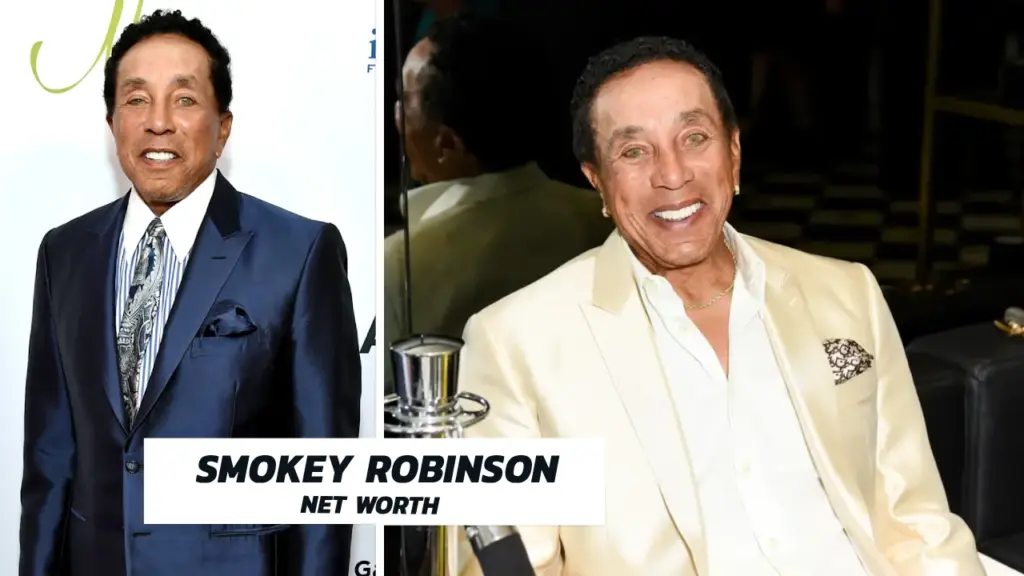
Smokey Robinson net worth is estimated at $150 million — a figure built not on a single breakout moment, but on sixty-plus years of ownership, output, and quiet financial discipline. He wrote the songs, shaped the label, performed the concerts, sold the real estate, and kept the royalties flowing long after most of his contemporaries faded from public life.
This article covers where that money came from, how it has shifted over time, what personal and legal setbacks have tested it, and what Robinson is still doing to keep it growing at 85 years old.
Who Is Smokey Robinson?
William “Smokey” Robinson Jr. was born on February 19, 1940, in Detroit, Michigan. He grew up in a low-income household in the city’s North End, became the co-founder and frontman of The Miracles, and went on to serve as vice president of Motown Records during its most commercially powerful years. As a solo artist, he scored top-ten hits well into the 1980s. As a songwriter, he produced material for some of the biggest names in American music.
Quick facts:
- Full name: William “Smokey” Robinson Jr.
- Date of birth: February 19, 1940
- Age (2026): 85 years old
- Birthplace: Detroit, Michigan, USA
- Net worth: ~$150 million
- Primary income sources: Music royalties, touring, Motown executive salary, real estate
- Spouse: Frances Gladney (married 2002); previously Claudette Rogers (1959–1986)
- Children: Berry Robinson, Tamla Robinson, Trey Robinson
From Detroit’s North End to Motown’s Corner Office
Understanding Smokey Robinson’s net worth means understanding where he came from — because the wealth he eventually built stands in sharp contrast to the circumstances he started with.
Robinson grew up poor in Detroit’s North End during the 1940s and ’50s. His uncle Claude took him to cowboy films regularly and gave him the nickname “Smokey Joe,” which the young William shortened to just “Smokey” when introducing himself to classmates. Music absorbed his childhood: he closely studied doo-wop acts he heard on the radio, including Nolan Strong & the Diablos and Billy Ward and his Dominoes, absorbing the emotional directness and harmonic precision that would later define his own voice.
During his high school years, he formed a vocal group called the Five Chimes, which later became the Matadors. That group’s connection with a young songwriter and music entrepreneur named Berry Gordy in the late 1950s changed everything. Gordy recognized Robinson’s gift for constructing melodies and writing lyrics that felt both poetic and commercially accessible. Their partnership became the creative nucleus of what would become Motown Records — and eventually the engine behind much of Robinson’s wealth.
The Career That Built the Fortune
Robinson’s financial story accelerates sharply in 1960 when The Miracles — the renamed Matadors — released “Shop Around” on Tamla Records, the precursor label to Motown. The track sold over a million copies and marked one of Motown’s earliest major commercial wins. With Robinson serving simultaneously as lead vocalist, chief songwriter, and in-house producer, his position at the label was unique: he was contributing on multiple revenue-generating fronts at once.
Throughout the 1960s, The Miracles generated a string of hits that remained commercially active for decades. Tracks like “You’ve Really Got a Hold on Me,” “The Tracks of My Tears,” “I Second That Emotion,” and “The Tears of a Clown” became standards of American popular music. In 1965, the group formally renamed itself Smokey Robinson & the Miracles to reflect his central role.
What made Robinson’s position especially valuable, financially, was his work outside the group. He wrote and produced songs for other Motown artists — The Temptations, the Marvelettes, Mary Wells, and Marvin Gaye, among them. Each songwriting credit on those records created a separate, ongoing royalty stream. That stacking of publishing rights across dozens of artists and hundreds of tracks is a significant reason why Robinson’s wealth has remained durable long after the peak years of his performing career.
Bob Dylan famously called Robinson “America’s greatest living poet.” That reputation, rooted in his lyrical precision, has kept his catalog culturally relevant across generations, which in turn keeps the licensing requests and streaming royalties coming.
Solo Artist and Motown Executive: Two Paychecks Running Simultaneously
By 1972, Robinson stepped away from The Miracles. The constant touring had worn him down, and he had a family to attend to. He took roughly a year away before returning as a solo artist in 1973 with the album Smokey, followed by Pure Smokey in 1974. The early solo output, while musically accomplished, didn’t produce immediate commercial breakthroughs — Robinson was competing in a market crowded with established solo artists from the very label he had helped build.
The turn came in 1975 with A Quiet Storm, which contained the hit tracks “Baby That’s Backatcha” and “Quiet Storm.” From there, Robinson worked in parallel on two fronts: his music career and his role as Motown’s vice president. The executive position gave him influence over the label’s direction, access to its business relationships, and a corporate salary — income that ran alongside his touring and publishing earnings.
His most commercially successful solo period arrived in the late 1970s and 1980s. “Cruisin'” reached the top ten in 1979. “Being with You” hit number one in 1981. The 1987 album One Heartbeat gave him “Just to See Her,” which won Robinson a Grammy Award in 1988 — the same year Motown was sold to MCA and Robinson stepped down from his vice president role to focus solely on his solo career.
Smokey Robinson’s Net Worth in 2026: Where the $150 Million Comes From
Most credible sources place Smokey Robinson’s net worth at approximately $150 million in 2026. That number reflects decades of income from several distinct channels, not a single windfall.
Songwriting and Publishing Royalties
This is the foundation. Robinson has written or co-written more than 4,000 songs over his career. Classic Motown tracks from the 1960s and 1970s continue generating income through streaming, radio airplay, film and television licensing, and cover recordings. Publishing ownership — or partial ownership — in a catalog of that size produces income that does not require Robinson to perform or actively work. These royalties have continued paying out for decades and will likely continue long after his performing years end.
Recording and Touring Income
From his Miracles-era recordings through to his solo albums, Robinson has earned from record sales across multiple formats. More significantly, he has continued performing live well into his eighties. Veteran artists of Robinson’s standing command considerable fees for festival appearances, tribute concerts, and special events. That touring income has remained a meaningful contributor to his financial position in recent years.
Motown Executive Role
During the years Robinson served as Motown’s vice president — from 1972 through 1988 — he received a salary and compensation package tied to one of the most commercially successful labels in American music. Beyond the direct income, that executive position gave him relationships, industry influence, and a depth of business experience that shaped how he managed his finances and career afterward.
SiriusXM and Media Appearances
In late 2023, Robinson became the owner and host of the SiriusXM channel Soul Town, expanding his media presence and creating an additional income stream with relatively low performance overhead.
Real Estate
California properties have added a tangible asset layer to Robinson’s financial picture. In 2002, he sold a historic 10,600-square-foot Encino estate — originally built in 1912 — for $2.3 million. The same property changed hands again in 2017 for $8.3 million, a figure that illustrates how significantly California real estate values appreciated over that period.
Robinson also listed a 9,075-square-foot Chatsworth mansion in 2014 at $7.99 million, having originally priced it at $10.5 million in 2005. While that property sold at a discount from its initial asking price, it still represented a significant asset transaction.
Personal Life and the True Financial Cost of His First Marriage
Robinson married Claudette Rogers — herself a member of The Miracles — in 1959. The couple had two children together. However, Robinson’s infidelity during their marriage contributed to their divorce in 1986. By most accounts, the settlement was substantial: reports indicate a cash payment of approximately $20 million, the transfer of two properties, and monthly alimony payments of $100,000 sustained over twelve years. That settlement alone represents a significant reduction from whatever his peak net worth was at the time.
In 2002, Robinson married Frances Gladney. The couple has remained together since, and Robinson has spoken publicly about stabilizing his personal life during that period. He has also been open about earlier struggles with substance abuse — marijuana and later cocaine — a chapter of his life he addressed and moved past, though it represented a period of personal and likely financial difficulty.
Legal Controversies and Their Financial Stakes
Robinson’s legacy carries substantial weight, but 2025 brought serious legal challenges. In May 2025, four former housekeepers filed a civil lawsuit in Los Angeles Superior Court naming Robinson and seeking approximately $50 million in damages. The lawsuit includes allegations of sexual battery, false imprisonment, and related misconduct, with incidents allegedly occurring at Robinson’s California and Nevada residences over several years. Frances Robinson is also named in the lawsuit in connection with labor-related allegations.
2026, no criminal charges have been filed, and Robinson has not publicly commented in detail on the allegations. The civil case remains in legal proceedings. Depending on how the litigation resolves, the financial and reputational implications could be significant — both in terms of any potential settlement and in terms of how his catalog and public image are managed going forward.
What Smokey Robinson Is Doing in 2026
At 85, Robinson continues to tour selectively, appear at major music events, and host his SiriusXM programming. His songs feature regularly in streaming playlists, film and television soundtracks, and commercial licensing — all generating income that requires no stage time from him.
His honors remain significant to his commercial value. Rock and Roll Hall of Fame induction in 1987 and the Library of Congress Gershwin Prize for Popular Song in 2016 position him as one of the formally recognized greats of American music, which keeps his catalog attractive to licensors and his name relevant to new audiences.
The streaming era has generally been favorable to legacy artists whose catalogs were recorded with consistent sound quality and whose songs carry emotional weight across generations. Robinson’s work — built around tightly crafted melodies, poetic lyrics, and his distinctive high tenor — fits precisely that profile.
FAQs
How much is Smokey Robinson worth?
Most estimates place Smokey Robinson’s net worth at approximately $150 million in 2026, built across music royalties, touring, real estate, and his former executive role at Motown Records.
How did Smokey Robinson make his money?
His wealth comes primarily from songwriting and publishing royalties on a catalog of more than 4,000 songs, record sales and touring as both a member of The Miracles and a solo artist, his salary and influence as Motown’s vice president from 1972 to 1988, and proceeds from several California real estate investments.
Did Smokey Robinson lose money in his divorce?
Yes. His 1986 divorce from Claudette Rogers reportedly included a cash settlement of approximately $20 million, two property transfers, and monthly alimony payments over twelve years — one of the more significant financial setbacks in his career.
Is Smokey Robinson still performing?
2026, Robinson continues to perform selectively. He also hosts a SiriusXM radio program, maintains an active public presence, and his catalog continues generating passive income through streaming and licensing.
How old is Smokey Robinson?
Robinson was born on February 19, 1940, making him 85 years old in 2026.
What awards has Smokey Robinson received?
He was inducted into the Rock and Roll Hall of Fame in 1987 and received the Library of Congress Gershwin Prize for Popular Song in 2016, among numerous other honors across his career.
The Bigger Picture: Why Smokey Robinson’s Wealth Has Lasted
Many artists of Robinson’s generation earned significant money during their peak years and saw it diminish afterward through poor management, costly divorces, or simple neglect. Robinson’s financial durability comes from a different model: ownership.
He owned songwriting and publishing rights. He held an executive position that gave him income beyond performance fees. He invested in real estate in markets that appreciated substantially over time. And crucially, he wrote songs that have been covered, sampled, licensed, and streamed for decades — a catalog-based income model that does not require his physical presence.
The result is a net worth that has held above $100 million for years and sat near $150 million heading into the mid-2020s, even accounting for the expensive first-marriage settlement and recent legal costs. That is not the story of a musician who got lucky. It is the story of someone who understood, early on, that writing and owning great music was more durable than any single performance — and built his financial life accordingly.