

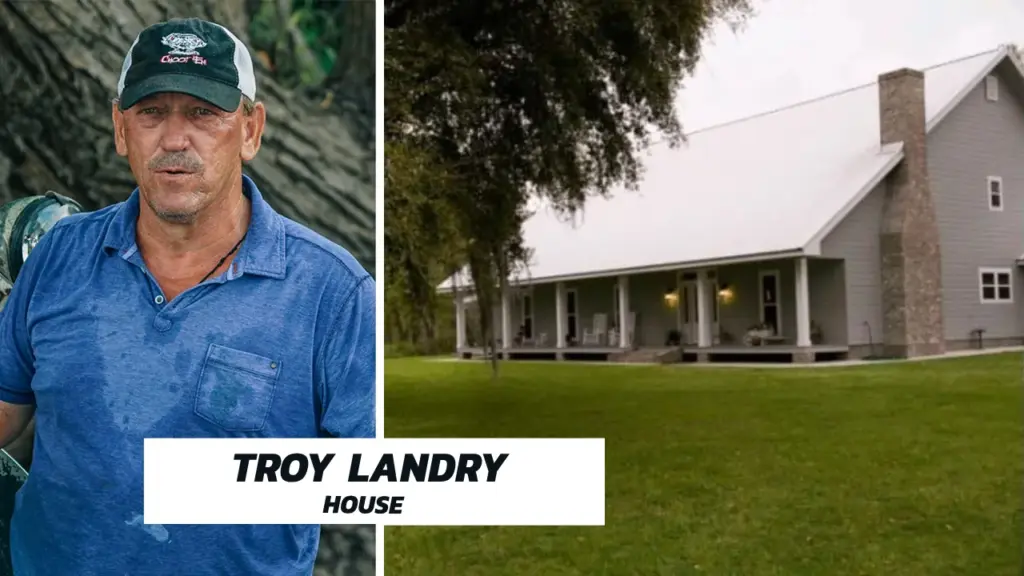
Troy Landry is one of the most recognizable faces on American reality television. As the star of the History Channel’s Swamp People and the self-proclaimed “King of the Swamp,” he spent decades building a reputation for fearless alligator hunting deep in the Atchafalaya Basin. But while his work takes place on the water, the story of where he lives is just as compelling.
The Troy Landry house in Pierre Part, Louisiana, is not a showpiece built for cameras or social media. It is the product of thirty years of careful planning, personal labor, and an unbreakable connection to the Louisiana bayou. Every beam, every cabinet, and every piece of furniture carries a story that no interior designer could manufacture.
This article covers everything worth knowing about Troy Landry’s home — its location, construction, layout, design, and the cultural weight it carries as a real piece of Louisiana heritage.
Where Troy Landry Lives: Pierre Part, Louisiana
The Troy Landry house sits on Mike Street in Pierre Part, Louisiana (LA 70339), positioned on a narrow strip of elevated ground along a two-lane highway running between Baton Rouge and Morgan City. The town itself has a population of roughly 3,000 people and sits inside Assumption Parish in southern Louisiana.
Pierre Part is not a suburb or a bedroom community. It is a working swamp town, shaped by Cajun culture, bayou water, and a way of life that has persisted for generations. The area sits within the broader Atchafalaya River Basin — the largest river swamp in the United States — and the natural environment is woven directly into the everyday rhythms of the community.
Troy Landry has lived here his entire life. He was born in Pierre Part on June 9, 1960, and grew up along the Atchafalaya River learning how to hunt, trap, and fish the same way his father and grandfather did before him. Five generations of the Landry family have worked these swamps as shrimpers, trappers, fishermen, moss peddlers, lumberjacks, and alligator hunters.
The house itself runs along the banks of Pierre Part Bayou, giving the property direct water access — a practical necessity for a man who spends much of his professional life navigating swamp channels by boat.
The Story Behind Building the House
What makes the Troy Landry house genuinely different from most celebrity homes is the way it was built. Troy and his wife, Bernita, lived in a small trailer on their three-acre property for more than thirty years while he collected the materials needed for construction.
Troy had a specific vision: a cypress wood home built from timber he pulled himself from the surrounding swamps. Over three decades, he carefully retrieved cypress logs from the Atchafalaya Basin and other nearby swamps, storing each one in a large shed on the property. When he finally had enough material, he took the lumber to a sawmill, trading half of it for the milling service and keeping the other half for his home.
“I had a dream of one day building a house with cypress from the Atchafalaya Basin swamps,” Landry has said. “I carefully stored each log that I pulled out of the swamps in a big shed until I could begin the construction of our dream home. When I had enough logs, I gave half of the lumber to the sawmill to have it sawed for me.”
The house was completed before Troy became a television personality. Contractor Danny Landry oversaw construction, and master carpenter Elson Templet handled the cypress kitchen cabinets and bathroom cabinetry. The result was a home built without a single piece of sheetrock — every wall surface, ceiling, and cabinet made entirely from cypress wood.
Bernita Landry has described the experience plainly: “We lived in a trailer on our three acres of land for more than 30 years, saving up to build this house. Now we have our dream house where our three sons and their families can gather and share time.”
Property Details and Home Specifications
The Troy Landry house sits on approximately three acres of land bordering Pierre Part Bayou. The core residence covers around 1,860 square feet, though additional porch areas and outdoor cooking spaces extend the usable footprint considerably.
Key property details:
- Address: Mike Street, Pierre Part, Louisiana 70339
- Reported value: Approximately $265,800
- Living area: Approximately 1,860 sq ft
- Bedrooms: 3
- Bathrooms: 3
- Lot size: Approximately 3 acres
The modest square footage reflects the practical character of the home. This is not a sprawling estate. It is a carefully built, deeply personal residence designed for the way the Landry family actually lives — gathering for meals, working on equipment, welcoming extended family, and maintaining access to the water.
Inside the Troy Landry House: Rooms and Design Details
The Family Room
The heart of the home is a large family room measuring 30 by 34 feet. Cypress boards cover the walls from floor to ceiling, and the collection of hunting trophies mounted throughout the space makes clear whose home this is. Fourteen white-tailed deer mounts line the walls, and an eleven-foot alligator head is displayed prominently — all harvested locally in the surrounding swamps.
The family room also contains Troy’s personal kitchen, positioned in one corner of the large open space. He built the room’s centerpiece himself: a twelve-foot dining table made from cypress that seats approximately twenty people. Sunday family meals, holiday gatherings, and crawfish boils for the extended Landry family all take place around this table.
Two Kitchens
The house has two fully functional kitchens, a detail that speaks directly to how the family uses the space. Bernita keeps an indoor kitchen for everyday cooking and household use. Troy has his own kitchen inside the family room — a working space where he prepares meals his way, without disrupting her domain.
“We had to have two kitchens,” Troy has explained with characteristic straightforwardness. “Bernita didn’t want me messing up hers with my cooking.”
A third cooking area sits outdoors on the covered porch, used specifically for large family events, crawfish boils, and entertaining. This outdoor kitchen overlooks Pierre Part Bayou, making it one of the most-used spaces on the property during warmer months.
The Covered Porch
The broad covered porch runs along the bayou-facing side of the home and functions as an outdoor living room during most of the year. It offers a direct view of Pierre Part Bayou and the surrounding wetlands. Between the outdoor kitchen, seating space, and water access, the porch is where much of the family’s social life happens.
Bathrooms
The three bathrooms in the home carry the same all-wood character as the rest of the house. Cypress cabinetry, crafted by master carpenter Elson Templet, lines each bathroom. Vintage and antique mirrors add personal touches that contrast with the raw wood surroundings.
The Pantry
Bernita Landry took personal charge of one design detail: a pantry built underneath the stairway, large enough to store the quantities of food a family that lives off the land typically keeps on hand. “I was the one who decided to build a pantry under the stairway,” she has noted.
The Outdoor Property: Boats, Tools, and Working Land
The three acres surrounding the house function as much as a work site as a yard. Troy’s professional life requires boats, traps, crawfish equipment, and a substantial amount of storage and maintenance capacity. The outdoor areas of the property are built around those needs.
The property includes a boat storage area housing Troy’s hunting vessels, a workshop for repairing equipment and building traps, and open yard space used for family gatherings. The land runs directly to the bayou, giving him water access without leaving his own property.
At the edge of the driveway, Troy mounted a street sign reading “Alligator Alley” on a telephone post. A custom truck with “King of the Swamp” graphics parked nearby confirms you’ve found the right address. After Swamp People became one of the most-watched shows in History Channel history, the house quietly became a tourist landmark. Tour boats along the bayou regularly point it out to visitors making the trip to Pierre Part.
The Landry Family Business Nearby
The house is central to a broader family presence in Pierre Part. Troy and his family operate Duffy’s Shell Station, a gas station and convenience store located at 4030 Hwy 70 South in Pierre Part. The business includes a warehouse used for cold storage of crawfish and alligators during season, and Troy has been known to work there personally, weighing crawfish catches from local fishermen and handling distribution.
Sons Jacob and Chase Landry, both of whom appear on Swamp People, live nearby and visit regularly. The home serves as the gathering point for the extended Landry family, particularly around food and seasonal hunting preparations.
Why the Construction Method Still Matters
Building an entire house from hand-salvaged cypress wood is not a common undertaking in any era. It requires patience, physical labor, and a working knowledge of the material that most people simply do not have. For Troy Landry, the process took the better part of his adult life before a single wall went up.
Cypress is one of the most durable naturally occurring building materials in the American South. It resists rot, repels insects, and holds up in the humid, water-adjacent conditions that define life in the Louisiana bayou. The choice was not just aesthetic — it was practical. A home built of cypress near a swamp will outlast most conventional construction in that environment.
The fact that no sheetrock was used anywhere in the house is an unusual choice by any modern standard. It means every wall surface is a natural, unfinished wood face — not painted drywall. The resulting interior has a texture and warmth that can’t be replicated with conventional materials.
Troy Landry and Pierre Part: A Five-Generation Story
The house is the most visible symbol of something deeper: a family that has worked the same land and water for five consecutive generations. Troy Landry did not arrive in Pierre Part as a television personality. He was born there, learned the swamp from his father, Duffy, and mother, Myrtle, and raised his own sons in the same tradition.
Swamp People debuted on August 22, 2010, and Troy appeared in every season from the beginning. Each season, the show follows alligator hunters with a limited number of state-issued tags, working a 30-day window to fill their quota. Hunting alligators in this region is a Cajun tradition spanning roughly 300 years, and the Landry family sits near the center of it.
The house Troy built is not separate from that story. It was constructed from materials he pulled out of the same swamps where he hunts. The furniture inside was made by his own hands. The trophies on the walls were taken from the land surrounding the property. The outdoor kitchen feeds the extended family that gathers under the same cypress roof he spent three decades building.
What the Troy Landry House Actually Represents
Fans who visit Pierre Part hoping to get a glimpse of the house are not just looking at a building. They are looking at the result of a very specific kind of life — one built on patience, physical skill, deep local knowledge, and a refusal to separate work from home.
The house sits at modest square footage, carries a reported value far below what most television personalities spend on real estate, and was built from materials its owner collected by hand over thirty years. It contains hand-built furniture, local trophies, two kitchens, and a porch that faces directly onto a Louisiana bayou.
That combination — practical, personal, locally rooted, and genuinely earned — is exactly what draws interest to it. There is no design firm credited in the interior, no landscape architect behind the yard, and no contractor who turned a blank check into a showcase property. What the Troy Landry house shows, more than anything else, is what happens when a man spends his entire life building exactly the place he intended to build.
Conclusion
The Troy Landry house in Pierre Part, Louisiana, stands as one of the most authentic celebrity homes in the American South. Constructed entirely from hand-salvaged cypress wood, built without a single piece of sheetrock, and completed after more than three decades of preparation, it reflects a standard of personal investment that most homes — celebrity or otherwise — simply cannot match.
Located at Mike Street, Pierre Part, LA 70339, valued at approximately $265,800, and spread across three acres of Louisiana bayou land, it is a working family home in every sense. The cypress dining table Troy built by hand, the two kitchens divided by practical necessity, the bayou-facing porch, and the walls lined with local trophies all tell the same story: a life fully committed to the place, the people, and the land it came from.