
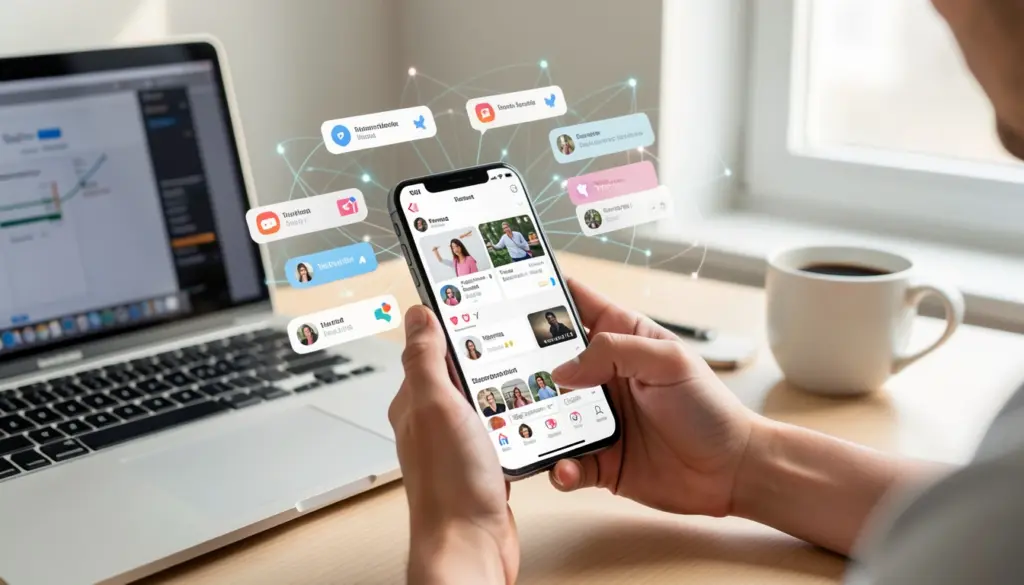
Billions of people open social media apps every single day — to share photos, watch videos, read news, message friends, and follow creators they admire. Yet most people never stop to think about what is actually happening behind the screen. How does a post reach the right people? Why does one video get millions of views while another gets none? What makes these platforms tick?
This guide explains social media platforms from the ground up. You will learn what they are, how they function, what the major platforms do differently, and how content travels from one person to another across a global network. Whether you are completely new to social media or simply want to understand it better, this breakdown covers everything you need to know.
What Are Social Media Platforms?
A social media platform is a website or application that allows people to create profiles, share content, and interact with others online. These platforms act as digital spaces where users can communicate, express themselves, and connect with people who share similar interests — whether they live next door or on the other side of the world.
Unlike traditional websites that simply publish information, social media platforms are built around participation. The content on these platforms is created almost entirely by the people who use them, which is why the term user-generated content is so closely associated with social media.
At the most basic level, a social media platform is a structured environment with tools that allow people to post, react, comment, follow, and share. The platform provides the infrastructure; the users provide the content that makes it worth visiting.
Key Features Found on Most Social Media Platforms
Despite their differences in format and purpose, nearly every social media platform shares a core set of features that define how users experience it.
User Profiles
Every platform gives users a personal profile — a dedicated page that represents them on the platform. A profile typically includes a name, photo, short bio, and a collection of everything the user has posted. It functions as a digital identity, telling other users who you are and what kind of content you share.
Content Posting and Sharing
The ability to post content is the foundation of any social media platform. Depending on the platform, users can post text updates, photos, videos, links, audio clips, or combinations of these. Sharing is just as important — most platforms let users forward or repost content from others, which is one of the primary ways information travels across a network.
Followers, Friends, and Connections
Social media platforms are built around relationships. Depending on the platform, these relationships are called followers, friends, connections, or subscribers. Together, these connections form what is known as the social graph — the network structure that determines what content flows between which users, and how far information travels across a platform. When you follow someone, their content appears in your feed.
Messaging and Communication
Most platforms include private messaging tools that let users communicate directly, separate from public posts. Some platforms, like Snapchat and WhatsApp, are built almost entirely around private messaging, while others treat it as a secondary feature alongside public content sharing.
How Social Media Platforms Actually Work
Understanding the mechanics behind social media requires looking at three connected stages: how content is created, how it gets distributed, and how users engage with it.
Content Creation
When a user posts something — a photo, a video, a status update — they are adding a piece of content to the platform’s database. The platform stores this content and associates it with the user’s profile and relevant metadata: timestamp, location (if shared), hashtags, captions, and audience settings. This metadata plays a significant role in determining who eventually sees the post.
Content Distribution
Once content is published, the platform decides how widely to show it. This is where the platform’s algorithm comes in. At a basic level, content gets distributed to the people who follow the creator. But algorithms can push content far beyond that original audience if early engagement signals are strong — more on that in the next section.
Hashtags and keywords also help with distribution. When a user includes a hashtag like #travel or #cooking, their post becomes discoverable to anyone searching for or following that topic, even if they do not follow the original poster.
Engagement and Interaction
Engagement is the term used to describe how users respond to content. Likes, comments, shares, saves, and reactions are all forms of engagement. These actions are not just social gestures — they are signals that platforms use to measure whether content is worth showing to more people. A post that receives strong engagement shortly after being published is far more likely to be distributed widely than one that is ignored.
This feedback loop between content, engagement, and distribution is the engine that keeps social media platforms running.
How Social Media Algorithms Organize Content
One of the most misunderstood aspects of social media is the algorithm — the system that determines what content each user sees and in what order.
Early social media platforms showed content in simple reverse-chronological order: the newest posts appeared at the top. As platforms grew and users followed more accounts, this approach became unmanageable. A person following 500 accounts could not possibly scroll through thousands of daily posts, so platforms began using algorithms to organize feeds.
A social media algorithm analyzes a range of signals to predict what a particular user is most likely to find relevant or interesting. These signals typically include:
- Engagement history — what types of content the user has liked, commented on, or shared in the past
- Relationship strength — how often the user interacts with a specific person or account
- Content freshness — how recently the post was published
- Post format — whether the user tends to prefer videos, photos, or text
- Trending topics — content that is gaining attention across the broader platform
Each platform weighs these signals differently, which is why the same person’s feed looks completely different on Instagram versus LinkedIn or TikTok.
It is worth noting that algorithms are not designed to show users only what they already like. They also surface new content — from accounts a user does not follow — to keep the experience fresh and encourage discovery. This is how creators with small audiences can occasionally reach massive audiences overnight.
Types of Social Media Platforms
Not all social media platforms serve the same purpose. They fall into several broad categories, each built around a different kind of interaction or content format.
Social Networking Platforms
These are the most traditional forms of social media. They focus on connecting people — friends, family, colleagues — and sharing updates about daily life. Users build a network of contacts and share text posts, photos, and links within that network. Facebook is the most widely recognized example.
Video Sharing Platforms
These platforms are built around video content. Users upload videos, others watch and comment, and the most-watched content gets promoted by the platform. YouTube pioneered this category and remains its largest example, while TikTok introduced short-form vertical video and transformed how people consume video content online.
Photo Sharing Platforms
Photo-first platforms organize content around visual imagery. Instagram is the dominant example, letting users share photos and short videos with a following. These platforms place high importance on aesthetics, and many creators build entire careers around a distinctive visual style.
Professional Networking Platforms
LinkedIn occupies a distinct space in social media by focusing on professional relationships and career development. Users share work achievements, industry insights, and job opportunities rather than personal life updates. The tone and purpose are noticeably different from consumer-facing platforms.
Major Social Media Platforms and Their Purpose
Each major platform has developed a distinct identity, user base, and primary use case — the result of decades of iteration you can trace through the full history of how social media platforms evolved.
Facebook is the largest social networking platform in the world by total user count. It connects people across age groups and geographies, supporting personal profiles, group communities, business pages, events, and a marketplace for buying and selling. It is particularly strong for community-building around shared interests, local groups, and family connections.
Instagram is a visual platform centered on photos and short videos. It introduced features like Stories (short-lived posts that disappear after 24 hours) and Reels (short-form video), which have become central to how younger audiences use the platform. Brands, photographers, fitness creators, and lifestyle influencers are especially active here.
TikTok
TikTok is a short-form video platform that relies heavily on its recommendation algorithm. Unlike most platforms where content distribution depends on follower counts, TikTok can push a video from an account with zero followers to millions of viewers if the content performs well. This has made it one of the fastest-growing platforms for new creators.
YouTube
YouTube is the world’s largest video-sharing platform and the second most visited website globally. It hosts everything from three-minute music videos to multi-hour documentaries and live streams. Because videos are searchable and remain discoverable for years, YouTube functions as much like a search engine as it does a social platform.
LinkedIn is designed for professionals. People use it to share career milestones, post industry commentary, recruit employees, and find job opportunities. It is the go-to platform for B2B marketing, professional development, and building a public reputation within a specific industry.
X (formerly Twitter)
X is a text-first platform built around short posts and real-time conversation. It is widely used for breaking news, public debate, commentary, and direct communication between public figures and their audiences. Hashtags and trending topics make it easy to follow conversations around specific events or subjects as they unfold.
How People Use Social Media Platforms
People use social media for a surprisingly wide range of purposes, and motivations vary significantly by platform and demographic.
Some people use social media primarily to stay connected — checking in on friends and family, sharing life updates, and keeping relationships active across distance. Others use it as an entertainment channel, spending hours watching videos, discovering new creators, or following trending content.
A growing number of people use social media for information. News organizations, journalists, health professionals, and educators all publish content on social platforms, making them a primary source of information for many users. These same platforms have also fundamentally changed how people make purchasing decisions, with content discovery and peer recommendations now central to the modern buying process.
Creators and businesses use these platforms differently — as tools for building audiences, promoting products, and reaching customers. For many creators, social media is a full-time career built on producing consistent content, growing a following, and generating income through ads, sponsorships, or product sales.
How Social Media Builds Online Communities
One of the most powerful aspects of social media is its ability to bring together people who share a common interest, identity, or goal — regardless of where they live.
Communities form around almost every imaginable topic: cooking, gaming, mental health, vintage cars, local politics, language learning, and niche hobbies. On platforms like Facebook and Reddit, these communities are formalized through groups or forums. On others like Instagram or TikTok, they emerge organically through hashtags and shared content styles.
Within these communities, consistent members become recognizable figures. Regular contributors earn trust, gain followers, and often become informal leaders who shape the direction of conversation. This social layer — where people know each other, reference shared in-jokes, and rally around common interests — is what separates social media from passive media like television or radio.
Community engagement also creates loyalty. When users feel a sense of belonging on a platform, they return more frequently, spend more time there, and produce more content — which feeds back into the platform’s growth.
The Role of Social Media in Modern Communication
Social media has fundamentally changed how people communicate, share information, and form relationships. It has collapsed geographic barriers, allowing a teenager in Brazil and a professional in Japan to interact around shared interests in real time.
For public figures, social media has eliminated the traditional gatekeepers of communication. Politicians, celebrities, scientists, and executives can speak directly to their audiences without going through media organizations — and audiences can respond directly in return.
For businesses, social media has become one of the most direct channels for reaching customers, gathering feedback, and managing public reputation. Small businesses that previously had limited reach can now build significant audiences at relatively low cost.
The ability to create, share, and discover content at scale — instantly, globally, and interactively — is what makes social media so different from any communication tool that came before it.
FAQs
What is the difference between social media and social networking?
Social networking refers specifically to connecting with other people — building and maintaining relationships online. Social media is a broader term that includes all platforms where users create and share content, which may or may not be focused on personal connections. All social networking happens on social media, but not all social media is purely about networking.
How do posts spread on social media?
Posts spread through a combination of follower distribution, algorithmic promotion, and user sharing. When a post receives strong early engagement — likes, comments, shares — the platform’s algorithm treats this as a signal of quality and shows the post to a larger audience. Users sharing posts with their own followers compounds this effect and can push content far beyond its original reach.
Why are some posts seen by more people than others?
Platform algorithms prioritize content based on multiple signals: how much engagement a post receives, how relevant it is to each user’s past behavior, how recently it was published, and how well it fits the format the platform currently favors (such as short video). Posts that align with all these factors tend to reach far more people.
Do you need a large following to go viral?
Not necessarily, especially on platforms like TikTok. While a large following gives content a head start, algorithms on most modern platforms are capable of distributing content to broad audiences based purely on performance signals — meaning a new account can occasionally reach millions of viewers with the right content.
How do businesses use social media platforms?
Businesses use social media to build brand awareness, engage with customers, promote products and services, run paid advertising campaigns, and handle customer service. They may also partner with creators who already have established audiences to reach new customers through trusted voices in a particular community.
Is social media the same as the internet?
No. Social media platforms are websites and apps that exist on the internet, but the internet itself is a much larger infrastructure that includes email, search engines, websites, streaming services, and more. Social media is one part of the broader internet, not the whole thing.