

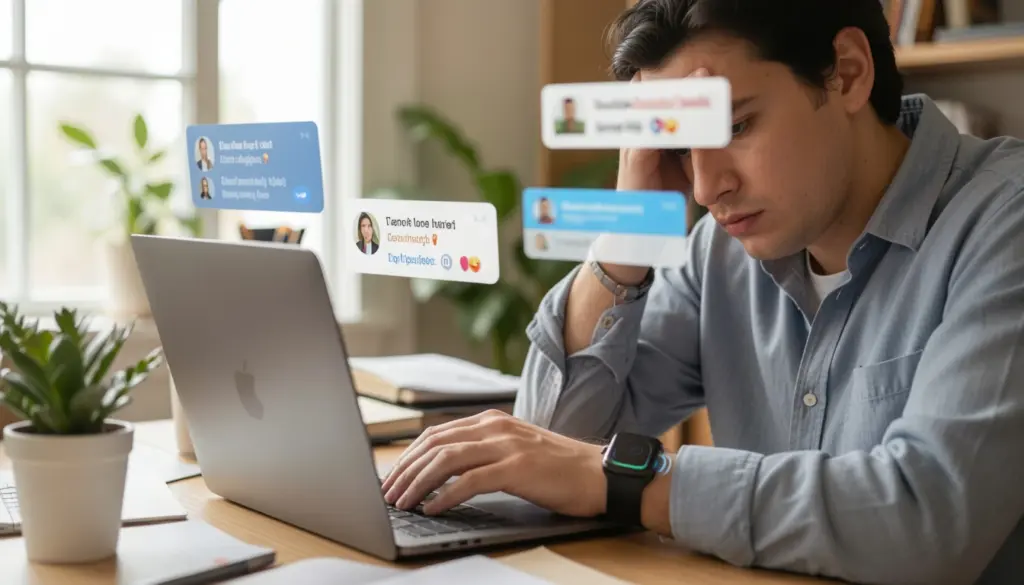
Your phone buzzes. A Slack message appears. A news alert slides in from the corner of your screen. Before you know it, fifteen minutes have passed, and you’re nowhere near where you left off in your work.
This isn’t a personal failure — it’s the predictable result of working inside an environment that was never designed with your concentration in mind. Digital tools have made us faster, more connected, and more capable in many ways. But they’ve also introduced a relentless stream of interruptions that chip away at sustained thinking.
This article explains why focus has become so difficult, what’s happening in your brain when you lose it, and — most importantly — how to build a practical system for getting it back. Whether you work in a busy office or from home, these strategies are grounded in cognitive science and designed to be applied immediately.
Why Focus Is Harder in the Digital Age
The average professional now switches between apps and browser tabs dozens of times per hour. Each switch carries a cost — not just time, but mental energy. Researchers refer to this as task-switching cost: the cognitive penalty your brain pays every time it has to reorient itself to a new context.
Attention spans haven’t collapsed entirely, but the threshold for distraction has dropped significantly. Technology companies design their platforms to capture and hold attention, using variable reward systems — the same psychological mechanism found in slot machines. Every notification, like, and refresh creates a small dopamine release, which over time trains the brain to crave interruption rather than resist it.
The result is what cognitive scientists call fragmented attention: an inability to sustain focus on a single task long enough to do meaningful work. For professionals, this translates directly into lower output quality, longer task completion times, and a persistent feeling of being busy without being productive.
Common Digital Distractions Professionals Face
Before you can address distraction, it helps to identify where it’s actually coming from. Most professionals deal with three main categories:
Notifications and push alerts are the most immediate problem. Email pings, calendar reminders, messaging apps, and software updates all compete for your attention throughout the day. Research consistently shows that even a brief interruption — a notification you glance at and dismiss — can take over twenty minutes to fully recover from in terms of depth of focus.
Social media and passive browsing are subtler but equally disruptive. Opening a browser tab “just to check something quickly” often leads to an unplanned detour through news feeds, videos, or articles. Social platforms are engineered to extend time-on-site, making it genuinely difficult to leave after a short visit.
Information overload is the third and often underappreciated factor. When you’re constantly exposed to new information — emails, reports, chat threads, shared documents — your brain spends significant energy processing and organizing incoming data, leaving less capacity for deep, focused thinking. Cognitive load theory describes this precisely: working memory has a limited capacity, and flooding it with input reduces the quality of everything you’re trying to process.
The Science Behind Focus and Distraction
Understanding why distraction works the way it does helps clarify why basic willpower alone rarely fixes the problem.
Cognitive Load and Attention Limits
Cognitive load refers to the total amount of mental effort being used in working memory at any given time. When you’re juggling multiple inputs — an open chat window, background noise, a complex task, and an unread email count ticking upward — your cognitive load rises. At a certain point, the brain can no longer maintain quality processing across all of those demands simultaneously.
This is why trying to work on a difficult task while monitoring messages is so exhausting: you’re not actually multitasking in the way it feels. The brain is rapidly toggling between tasks, each switch consuming a small amount of processing bandwidth. Over a full workday, this adds up to substantial mental fatigue.
The Multitasking Myth
Decades of research in cognitive psychology have established that true multitasking — doing two cognitively demanding tasks at once — is not something the human brain does well. What most people call multitasking is actually rapid task-switching, and it reliably reduces the quality and speed of both tasks involved.
A Stanford study found that heavy multitaskers were actually worse at filtering out irrelevant information than people who focused on one thing at a time. The habit of splitting attention doesn’t sharpen the mind — it gradually degrades its ability to concentrate deeply. This is particularly relevant for knowledge workers whose output depends on sustained analytical thinking.
Proven Strategies to Improve Focus
Once you understand the mechanics of distraction, the strategies for addressing it become much clearer. These aren’t quick hacks — they’re structured approaches that address the root causes.
Time Blocking and Structured Work Sessions
Time blocking is the practice of scheduling specific blocks of time for specific types of work, rather than working reactively through a to-do list. Cal Newport, who developed the concept of Deep Work, argues that the ability to focus without distraction is a skill — and like any skill, it requires deliberate practice and structure.
A practical implementation looks like this: dedicate two to three uninterrupted hours each morning to your most demanding tasks, then shift to meetings, emails, and collaborative work in the afternoon. The key is treating your focus blocks as non-negotiable appointments, not as aspirational time you’ll use if nothing else comes up.
The Pomodoro Technique
The Pomodoro Technique was developed by Francesco Cirillo in the late 1980s and remains one of the most widely used focus methods available. The structure is straightforward: work for 25 minutes without interruption, then take a 5-minute break. After four cycles, take a longer break of 15–30 minutes.
What makes this effective is that it creates a psychological contract with yourself. Knowing that a break is coming makes it easier to resist the urge to check your phone during the work interval. Over time, the technique also trains your attention span to sustain focus for longer stretches, since you can gradually extend the work intervals as concentration improves.
Reducing Notifications and Interruptions
This is the highest-leverage change most professionals can make immediately. Turning off non-essential notifications — across email, messaging apps, social media, and news — removes the most frequent triggers of distraction before they can interrupt your work.
A more structured approach is to designate specific times for checking messages, rather than responding in real time throughout the day. This is sometimes called batching communication: instead of checking email every twenty minutes, you check it at 9 am, 1 pm, and 4 pm. Studies on this approach show meaningful reductions in stress and significant gains in focus time.
Single-Tasking vs. Multitasking
Single-tasking — choosing one task and working on it to completion before moving on — is the direct antidote to fragmented attention. This sounds obvious, but it requires deliberate effort in environments where switching between tools and conversations is the default mode.
A useful habit is to keep only what you need for the current task visible on your screen. Close unnecessary browser tabs, minimize irrelevant apps, and if possible, use a full-screen view to reduce visual clutter. Reducing the availability of distractions lowers the effort needed to resist them.
Tools and Apps to Reduce Digital Distractions
Technology created the problem, and when used intentionally, it can also be part of the solution.
Website blockers like Freedom, Cold Turkey, or the Focus mode built into many operating systems allow you to block access to distracting sites during work hours. These are particularly useful because they remove the need for constant willpower — the site simply isn’t accessible, so the temptation doesn’t arise.
Focus and productivity apps such as Todoist, Notion, or Things help reduce the mental overhead of organizing tasks, which lowers cognitive load and keeps your attention where it belongs. Having a clear, trusted system for capturing tasks means your brain isn’t spending background energy trying to remember what needs to be done.
Screen time trackers — available natively on iOS, Android, and macOS — provide an honest picture of where your time actually goes. Most people significantly underestimate how much time they spend on social media or news sites. Reviewing this data weekly can be a powerful motivator for change, because it replaces vague guilt with specific, addressable behavior.
How to Build Long-Term Focus Habits
Short-term strategies can produce quick improvement, but sustainable focus requires building habits that hold up under pressure.
Daily Routines for Professionals
A consistent daily structure reduces the number of decisions you need to make, which preserves mental energy for work that matters. A morning routine — even a simple one — signals to your brain that work is beginning and primes it for concentration. This might include reviewing your priorities for the day, silencing notifications, and starting immediately with your most important task rather than easing in through email.
End-of-day routines are equally important. Spending five minutes reviewing what you accomplished and writing a short list for the next day provides a sense of closure that makes it easier to mentally disconnect from work — which is essential for recovery and sustained performance over time.
Mindfulness and Mental Clarity
Mindfulness meditation has a growing body of evidence behind it as a tool for improving attention. Even short sessions — ten to fifteen minutes of focused breathing — strengthen the neural circuits associated with sustained attention and reduce the reactivity to distraction that makes focus difficult.
You don’t need to adopt a spiritual practice to benefit from this. Apps like Headspace or Insight Timer offer structured sessions specifically designed to train attention. The mechanism is simple: every time your mind wanders during meditation, and you bring it back, you’re practicing the same skill you need to refocus after a distraction at work.
Creating a Focus-Friendly Environment
Your physical and digital environment shapes your behavior more than most people realize. A workspace with visual clutter, noise, and easily accessible distractions will produce fragmented attention almost automatically. Cleaning up your physical workspace, using noise-canceling headphones, and keeping your desk clear of unrelated materials all reduce the sensory load that competes with concentration.
Digital minimalism — the practice of being intentional about which technology you use and how — is a useful framework here. Rather than adding more apps and tools, ask which ones are genuinely worth the attention they demand. Regularly auditing your digital environment and removing what doesn’t serve your work directly is a habit that compounds over time.
Designing a Distraction-Free Work Environment
Environmental design is one of the most underused strategies in attention management. The goal is to make focused work easy and distraction genuinely inconvenient — not the other way around.
Workspace setup matters more in remote work environments, where the boundaries between work and leisure are often blurred. A dedicated workspace — even if it’s just a specific corner of a room — helps the brain associate that location with work, which strengthens the mental shift into focus mode. Controlling ambient noise, whether through soundproofing, white noise, or headphones, removes one of the most common sources of involuntary attention switching.
Digital hygiene practices are the virtual equivalent. Keep your desktop clean, organize your files logically, and close applications you aren’t actively using. Use separate browser profiles or windows for work versus personal browsing. Set up your email client to check for new messages only at scheduled intervals rather than pushing alerts in real time.
Combining these physical and digital practices creates what researchers call a distraction-free workflow: an environment structured around protecting your attention rather than competing with it.
FAQs
Why is it so hard to focus with constant notifications?
Each notification creates a micro-interruption that pulls your attention away from the current task. Even if you don’t act on the notification, your brain has already begun processing it, which disrupts the mental state needed for deep work. Over time, repeated interruptions condition the brain to expect them, making it harder to sustain focus even in silence.
Does multitasking actually reduce productivity?
Yes — consistently, according to decades of research. What feels like multitasking is actually rapid switching between tasks, and each switch carries a measurable cognitive cost. Studies estimate that task-switching can reduce effective productivity by as much as 40% in knowledge work.
How long can a person realistically focus without a break?
Most research points to 90 minutes as the upper limit of high-quality focused work before mental fatigue sets in. Shorter sessions of 25–50 minutes, as used in the Pomodoro Technique, are more sustainable for most people and allow for steady work across a full day without burning out attention reserves.
What’s the fastest way to improve concentration at work?
Turning off non-essential notifications has the most immediate impact for most people. After that, starting each workday with a single high-priority task — before checking email — creates momentum that makes the rest of the day more productive.
Can mindfulness meditation actually improve focus?
Yes. Neuroimaging research has shown that regular mindfulness practice strengthens the prefrontal cortex, the brain region most associated with sustained attention and cognitive control. Even brief daily practice produces measurable improvements in the ability to resist distraction and return attention to the task at hand.
How do I manage screen time if my job requires constant computer use?
The goal isn’t to reduce screen time overall, but to make your screen use more intentional. Use website blockers to limit access to non-work content during working hours, batch your communication rather than monitoring it continuously, and take regular breaks away from screens to reduce mental fatigue and eye strain from blue light exposure.