

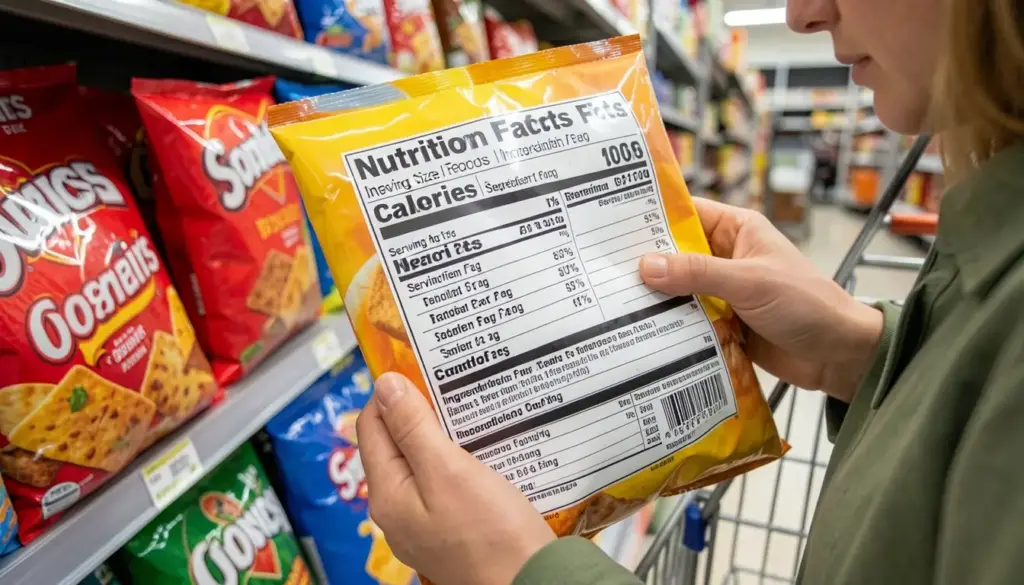
You pick up a box of granola bars at the store. The front says “natural,” “high protein,” and “low fat.” It sounds like a solid choice — until you flip it over. Suddenly, you’re staring at a wall of numbers, percentages, and unfamiliar terms that somehow make a snack feel like a chemistry exam.
This experience is more common than you’d think. Nutrition labels are packed with information, but most people were never taught how to actually read one. This guide fixes that.
By the end, you’ll have a simple, repeatable system for scanning any food label in about 60 seconds — and you’ll know exactly what to look for, what to ignore, and how to spot ingredients that manufacturers don’t always make obvious.
Why Nutrition Labels Feel Confusing (And How to Simplify Them)
The Nutrition Facts label was redesigned by the FDA to give consumers more clarity, and it genuinely contains useful information. The problem isn’t the label itself — it’s that most people try to read everything at once.
There are calories, fats, carbohydrates, sugars, protein, sodium, vitamins, minerals, and percentages all competing for your attention. Without a clear order of operations, it’s easy to latch onto one number (usually calories) and overlook everything else that actually tells you whether a food is nutritious.
The fix is simple: stop reading labels like a paragraph and start scanning them like a checklist. There are five specific things worth checking in a specific order. Everything else is secondary — or can be safely ignored for most daily decisions.
Step 1 — Start With Serving Size (Most People Get This Wrong)
Before any other number on the label makes sense, you need to know what it refers to. That’s the serving size — and it changes everything.
The serving size is the reference amount the manufacturer used when calculating all the other nutrition information on the label. If a bag of chips lists 150 calories per serving, but a serving is only 15 chips — and you typically eat 30 — you’re actually consuming 300 calories without realizing it.
Serving size vs. portion size is one of the most important distinctions in nutrition label reading. The serving size is defined by the manufacturer (with guidance from the FDA). Your portion size is how much you actually eat. These two numbers are often very different.
The updated FDA label now also requires manufacturers to include a “per package” column for items that could reasonably be eaten in one sitting — like a small bottle of juice or a snack-sized bag of pretzels. If you see two columns, the right-hand one tells you what you’d consume if you ate the whole thing.
Always check the serving size first. Then decide whether your actual portion is one serving, two servings, or somewhere in between — and mentally multiply accordingly.
Step 2 — Check Calories (But Don’t Stop There)
Once you know the serving size, calories are the next logical stop. Calories measure the energy a food provides, and they matter for overall energy balance. But treating calories as the only number worth caring about is one of the most common mistakes people make.
The reason is simple: not all calories work the same way in your body. 200 calories from oats with fiber and protein will affect your hunger, blood sugar, and energy very differently than 200 calories from a sugar-sweetened beverage with no nutrients at all. The first is what nutritionists call a nutrient-dense food — it provides meaningful nutrients alongside its calories. The second is closer to what gets called “empty calories” — energy with little nutritional value attached.
Calorie density is a useful context, too. A large bowl of leafy greens might total 40 calories, while a small handful of mixed nuts hits 170. Neither is bad — but knowing this helps you make informed decisions about volume and satiety.
Use calories as a reference point, not a verdict. A food isn’t automatically healthy because it’s low-calorie, and it isn’t automatically unhealthy because it’s high-calorie.
Step 3 — Understand Macros (Protein, Carbs, Fats Made Simple)
Macronutrients — protein, carbohydrates, and fat — are the three main categories of calories in food. Each one plays a distinct role in the body, and understanding even the basics helps you interpret labels more meaningfully.
What Each Macro Does
Protein is used for building and repairing tissues, supporting immune function, and keeping you full. It’s listed in grams on the label. For most adults, looking for foods with at least a few grams of protein per serving is a reasonable habit.
Carbohydrates are your body’s preferred energy source. The total carbohydrate line on the label includes everything: dietary fiber, naturally occurring sugars, and added sugars. Fiber is a carbohydrate your body can’t fully digest — it slows digestion, supports gut health, and helps manage blood sugar. A higher fiber number alongside total carbohydrates is generally a good sign.
Fat is listed as total fat, then broken down into saturated fat and trans fat. Saturated fat isn’t the villain it was once made out to be, but high intake is still associated with elevated LDL cholesterol in many people. Trans fat, on the other hand, is worth minimizing — it raises bad cholesterol while lowering good cholesterol. Most manufacturers have phased it out, but always worth checking.
What to Prioritize
For most people eating varied, minimally processed food, a useful macro habit is simply this: look for protein and fiber to be meaningfully present, and flag high amounts of saturated fat or trans fat. You don’t need to track every gram unless you’re managing a specific health condition or fitness goal.
Step 4 — Spot Hidden Sugar and Unhealthy Ingredients
Added sugars are one of the clearest red flags on a nutrition label — and one of the most deliberately obscured.
The label now separates “added sugars” from “total sugars,” which is helpful. Total sugars includes sugars naturally present in the food (like the lactose in yogurt or the fructose in fruit). Added sugars are what was put in during processing. The American Heart Association recommends most adults keep added sugars below 25–36 grams per day, depending on sex — yet some flavored yogurts, cereals, and granola bars contain 15–20 grams in a single serving.
Hidden Sugar Has Many Names
One of the more effective ways food companies reduce the appearance of sugar is by using it in multiple forms. When an ingredient is split into smaller amounts under different names, each one appears lower on the ingredient list — even though the total sugar content remains high.
Common names for added sugar in ingredient lists include: high-fructose corn syrup, cane juice, evaporated cane juice, dextrose, maltose, corn syrup solids, barley malt, agave nectar, fruit juice concentrate, and molasses. If you spot several of these in the same product, the cumulative sugar content is likely significant.
How to Read the Ingredient List
Ingredients are listed in descending order by weight. Whatever appears first is the most abundant ingredient in the product. If sugar (in any form) appears in the first three ingredients, the product is heavily sweetened regardless of what the front of the package says.
The ingredient list is also where you can identify the degree of processing. Whole, recognizable ingredients suggest a less processed product. A long list of chemical names, emulsifiers, and artificial colors generally points to a more processed product, which isn’t automatically disqualifying, but is worth knowing.
Step 5 — Use % Daily Value Like a Pro
On the right side of each nutrient row, you’ll see a number followed by a percent sign. This is the % Daily Value (%DV), and it tells you how much of that nutrient one serving contributes toward a standard daily intake of 2,000 calories.
The most useful rule for interpreting %DV is the 5% and 20% benchmark:
- 5% DV or less is considered low. Use this benchmark when checking nutrients you want to limit — like sodium, saturated fat, and added sugars.
- 20% DV or more is considered high. Use this when looking for nutrients you want more of — like dietary fiber, calcium, iron, and vitamin D.
For most daily eating, this rule is all you need. You don’t need to add up every percentage from every meal. Just scan the relevant nutrients for their %DV and use these two benchmarks as quick reference points.
Sodium is worth paying specific attention to. Dietary guidelines suggest keeping sodium below 2,300 milligrams per day for most adults. A single serving of canned soup can easily contain 800–900 milligrams — well over a third of the daily target — despite being perceived as a light or healthy meal.
The 60-Second Nutrition Label Checklist
Here’s the full system, condensed into a repeatable five-step scan:
- Serving size — How much is one serving? How many servings will you actually eat?
- Calories — How many calories per serving (adjusted for your actual portion)?
- Macros — Is there meaningful protein? Is fiber present? How do saturated fat and trans fat look?
- Added sugars — How many grams? Is sugar hiding under multiple names in the ingredient list?
- % Daily Value — Are sodium and saturated fat under 5% DV? Is fiber at 10% DV or higher?
That’s it. With practice, this scan takes under a minute and gives you a clear picture of whether a food is a reasonable choice for your goals. You won’t always have a perfect answer — tradeoffs are normal — but you’ll be making an informed decision rather than guessing based on front-of-package marketing.
Common Nutrition Label Mistakes Beginners Make
Ignoring the serving size. This is the most impactful error. A food might look low in everything — until you notice the container holds three or four servings, and you typically eat the whole thing.
Using calories as the only measure of quality. A 100-calorie pack of crackers and a handful of almonds have similar calorie counts. The almonds contain protein, healthy fats, and micronutrients. The crackers may offer little beyond refined starch. Calories matter, but they’re one data point, not the whole story.
Falling for front-of-package claims. Words like “natural,” “made with real fruit,” “multigrain,” and “low fat” have specific technical meanings — or sometimes no regulated meaning at all. “Low-fat” products frequently compensate with added sugar to maintain flavor. “Multigrain” means a product contains multiple grains, not that those grains are whole grains. The Nutrition Facts panel is the authoritative information source. Marketing language on the front is not.
Treating all fats as the same. Fat was demonized for decades, and many people still reflexively avoid high-fat foods without checking what kind of fat they contain. Olive oil, avocados, and nuts are calorie-dense, but their fat profiles are very different from those of a heavily processed snack food. Look at the fat breakdown, not just the total fat number.
How to Compare Two Products Quickly
When standing in front of two similar products — say, two brands of peanut butter or two cereals — this comparison approach makes the decision straightforward.
Start with serving size to make sure you’re comparing equal amounts. Then look at these four points in order: added sugars, fiber, protein, and sodium. The better product will generally have lower added sugars, higher fiber, comparable or higher protein, and lower sodium.
Example: Cereal A has 12g total carbohydrates, 3g fiber, 1g added sugar, and 4g protein per serving. Cereal B has 28g total carbohydrates, 1g fiber, 11g added sugar, and 2g protein. Even if both had the same calorie count, Cereal A provides substantially more nutritional value and far less sugar — a clear winner for most health goals.
The ingredient list reinforces this. If Cereal A’s first ingredient is whole grain oats and Cereal B’s first ingredient is sugar, the comparison is already settled before you even read the numbers.
FAQs
What is the most important thing to look at on a nutrition label?
Start with the serving size — it puts every other number in context. After that, the most decision-relevant information for most people is added sugars, fiber, protein, and sodium.
What does % Daily Value actually mean?
It tells you how much of a given nutrient one serving provides as a percentage of the recommended daily intake, based on a 2,000-calorie diet. Use 5% as a “low” benchmark and 20% as a “high” benchmark for quick decisions.
How can I spot hidden sugar in packaged food?
Check the ingredient list for multiple names that all mean sugar: dextrose, maltose, cane juice, corn syrup, fruit juice concentrate, agave nectar, and similar terms. The more of these appear, the higher the total sugar content is likely to be — even if no single form is listed first.
Are calories more important than nutrients?
For weight management, total calorie intake matters. But for overall health and energy, the quality of those calories — the nutrients they come with — matters just as much. A food can be low in calories but poor in nutrients, or high in calories but very nutritious.
Why are serving sizes misleading?
Serving sizes are set by manufacturers within FDA guidelines, not necessarily based on how much a person typically eats. A small bag of chips or a can of energy drink may technically list “2.5 servings,” even though most people consume the whole container. Always check.
How do I know if a food is healthy just from the label?
No single number defines “healthy,” but a useful shortcut is this: look for meaningful protein and fiber, added sugars under 5g per serving, sodium under 15% DV, and a short ingredient list with recognizable whole-food ingredients near the top.
What should I avoid on food labels?
Trans fat (ideally at 0g), very high added sugars (10g+ per serving), high sodium (over 20% DV), and lengthy ingredient lists dominated by refined starches, artificial additives, or multiple forms of sugar.
How do I read macros on a food label?
Find the section labeled “Total Fat,” “Total Carbohydrate,” and “Protein” — these are your three macronutrients. Each is listed in grams. Carbohydrates are further broken down into dietary fiber and sugars, which is where much of the useful detail lives.