

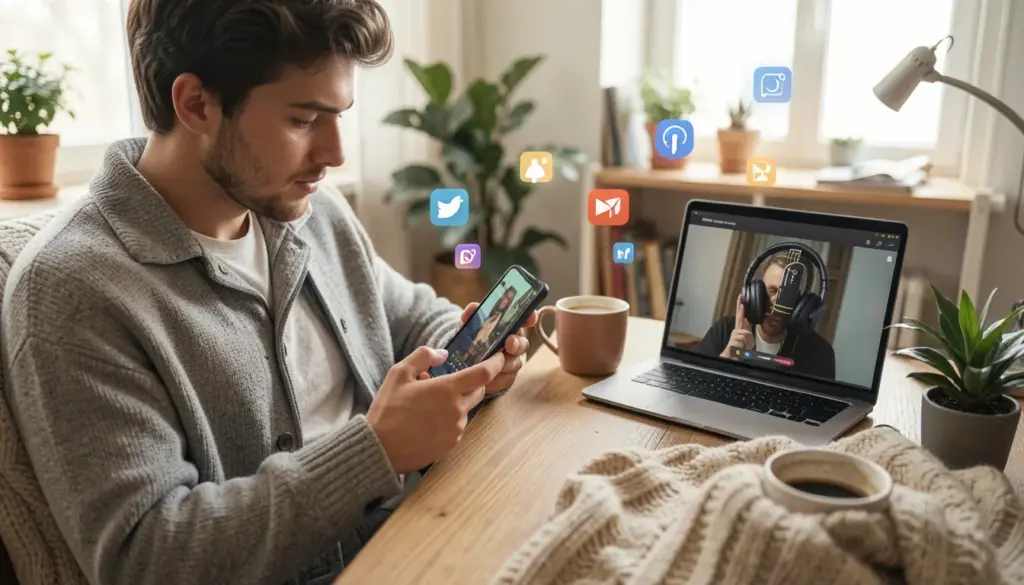
The average person now interacts with media across more surfaces, for more hours of the day, and in more fragmented ways than any previous generation. A commuter scrolls through TikTok, switches to a podcast during lunch, half-watches Netflix in the evening while checking Instagram, and catches up on headlines before bed — often without a single moment of what you’d call focused, single-screen attention.
This isn’t a distraction. It’s the new architecture of media consumption.
Understanding how people actually engage with content matters far beyond marketing strategy. It shapes how journalism survives, how entertainment gets funded, how attention itself gets priced, and how platforms are designed. Whether you’re a researcher, a content creator, a student of digital behavior, or simply curious about your own habits, this article breaks down the patterns, the platforms, and the psychological wiring behind modern media behavior.
Understanding Modern Media Consumption Habits
Digital media has not simply replaced traditional media — it has restructured the entire relationship between audiences and content. Where television once commanded a household’s attention at fixed hours, digital platforms deliver content on demand, algorithmically tailored to individual preference, accessible on any screen, at any time.
Global daily time spent on digital media now consistently exceeds six hours per person, according to data from sources like DataReportal and Statista. Social media alone accounts for roughly two and a half hours of that daily figure. By contrast, traditional television viewership has been declining steadily for over a decade, particularly among audiences under 40.
What defines modern consumption behavior isn’t just where people get their media — it’s the pace and format they expect. Short-form content, episodic releases, and algorithm-curated feeds have conditioned audiences to expect content that matches their preferences with minimal friction. Discovery is no longer driven by broadcast schedules or editorial gatekeepers. It’s driven by engagement signals fed back into recommendation systems.
That shift in control — from broadcaster to algorithm to individual — is the central story of media consumption in the 2020s.
Platform-Specific Media Behavior
Social Media: Speed, Volume, and Visual Language
TikTok has arguably done more to reshape content consumption expectations than any other platform of the past decade. Its algorithm prioritizes completion rates and replays over follower counts, meaning any creator — regardless of audience size — can reach millions if the content holds attention. This has compressed the expected hook time for video content to under two seconds in many categories.
Instagram functions differently: it’s a hybrid of social connection, aspiration content, and short-form video through Reels. Users tend to engage in shorter, more browsing-oriented sessions compared to TikTok’s deeper scroll loops. YouTube sits at a different point on the attention spectrum — it commands longer sessions, stronger search intent, and higher audience loyalty for niche topics. It also serves as the default platform for educational content, tutorials, and long-form commentary.
Streaming: On-Demand as the Default
Streaming has moved from a novelty to the baseline expectation for audio-visual entertainment. Netflix, with over 300 million subscribers globally, helped establish the binge-watching model — full season drops that invite multi-episode viewing in one sitting. That model is now evolving: some platforms have returned to weekly episode releases to sustain subscriber engagement over longer periods.
The streaming landscape has become significantly more crowded, with Disney+, HBO Max, Apple TV+, Amazon Prime Video, and regional services all competing for attention. This fragmentation has introduced a new consumer behavior: subscription rotation. Viewers subscribe, consume a specific title, then cancel — cycling through platforms rather than maintaining long-term loyalty to any one service.
Podcasts: Audio in the Age of Multitasking
Podcast listenership has grown consistently over the past several years. Spotify now hosts millions of podcast episodes and has invested heavily in exclusive audio content. The medium works precisely because it doesn’t compete with the eye — listeners engage while commuting, exercising, cooking, or doing household tasks. This makes it one of the few media formats that genuinely adds time to a day rather than displacing another activity.
News podcasts, true crime, business analysis, and interview formats dominate consumption patterns. The audience tends to skew toward adults aged 25–54, with higher-than-average education and income levels, which also makes it an attractive format for advertisers seeking engaged, attentive audiences.
Traditional Media: Decline, Not Disappearance
Linear television still holds ground with older demographics. Adults over 55 remain the most consistent traditional TV audience, and live events — sports broadcasts, award ceremonies, breaking news — still draw large simultaneous viewership that streaming currently can’t replicate in scale. Print journalism has declined significantly in circulation but maintains authority in digital form, particularly for long-form investigative content.
Radio has similarly migrated rather than disappeared: AM/FM listening has declined while digital audio — streaming radio, podcasts, and music platforms like Spotify have grown.
Demographics and Generational Differences
Media consumption is not uniform across generations, and treating it as such leads to significant misreads of audience behavior.
Gen Z (born approximately 1997–2012) grew up entirely within the smartphone era. Their media habits are characterized by short-form video, platform-switching, and a strong preference for creator-led content over institutional media. They trust individual voices — YouTubers, TikTok creators, Substack writers — more than traditional news anchors or network programming. They’re also less likely to maintain long-term platform loyalty, moving toward newer apps as social norms shift.
Millennials (born approximately 1981–1996) represent the bridge generation. They adopted social media during its formative years — Facebook, Twitter, early YouTube — and now primarily inhabit Instagram, LinkedIn, YouTube, and streaming platforms. They’re the core audience for podcast content and are more likely than Gen Z to pay for premium subscriptions. Their media behavior combines digital fluency with habits partially formed during the pre-smartphone era.
Gen X (born approximately 1965–1980) shows more mixed consumption patterns. This group uses social media actively, particularly Facebook and LinkedIn, but also retains stronger habits around traditional television and news. They’re a significant segment of podcast listeners and streaming subscribers.
Baby Boomers and older adults remain the most consistent consumers of linear television and print-based media. However, this demographic has been increasingly adopting smartphones and tablets, particularly for news, video calls, and YouTube content. The idea that older adults are entirely outside the digital media landscape is outdated — smartphone penetration in this age group has grown substantially.
These generational differences matter because they reflect different relationships with attention, trust, and content format — not simply different platform preferences.
Mobile Devices and Multitasking Effects
The smartphone is the defining tool of modern media consumption. It has made content consumption continuous rather than scheduled — available in every idle moment, every queue, every waiting room. Global data consistently shows that mobile devices account for more than half of all digital media time, with that figure even higher in developing markets where smartphones often serve as the primary (and sometimes only) internet-connected device.
This constant availability has produced a behavior pattern researchers call media multitasking: engaging with two or more media streams simultaneously. Someone watching television while scrolling a social feed, or listening to a podcast while reading emails, is exhibiting cross-platform consumption behavior that is now statistically the norm rather than the exception.
The cognitive implications are significant. Research from institutions including Stanford has explored how media multitaskers often experience reduced ability to filter irrelevant information and more difficulty sustaining deep focus on a single task. This doesn’t mean multitaskers are less intelligent — but it does suggest that habitual media multitasking reshapes attention patterns in ways that affect how people engage with content overall.
For content creators and publishers, this has practical consequences. Content designed for distracted audiences — with visual cues, captions, strong openings, and punchy structure — performs better across most digital platforms than content that assumes focused, linear attention. The rise of auto-captioned video, text overlays, and mobile-first vertical video formats all reflect design choices made in response to real audience behavior.
Behavioral Drivers and Psychological Factors
Why do people gravitate toward specific platforms or content types? The answer involves both deliberate choice and structural psychology.
Algorithmic reinforcement plays a central role. Platforms like YouTube, TikTok, and Spotify are built around recommendation engines that surface content based on previous behavior. These systems are extraordinarily good at predicting what a user will engage with next, creating feedback loops where consumption patterns become self-reinforcing. A viewer who watches one true crime video is likely to be served another — and another — until true crime becomes their dominant content category, even if that wasn’t a conscious preference before.
Social validation drives behavior on platforms where engagement is public. Likes, shares, comments, and follower counts create an environment where content consumption and production both have social stakes. People consume content partly to participate in shared cultural conversations — to have seen the thing everyone is discussing, or to discover content they can share within their social networks.
Escapism and emotional regulation are also significant drivers. Research consistently finds that entertainment media — including scripted television, gaming, music, and social video — serves an emotional function for many users. Binge-watching behavior, for example, is often linked to stress relief and mood management rather than simple entertainment preference. The accessibility of on-demand content means this emotional regulation is now available with virtually no friction.
Content format preferences are also shaped by context. The same person who prefers long-form documentary content on weekends may default to short-form video on a weekday commute. Media behavior is situational — it adapts to available time, attention capacity, and social context.
Future Trends in Media Consumption
Several clear directions are shaping how media consumption will continue to change.
Short-form video will remain dominant, but the competition for short attention has already pushed creators toward higher production quality and faster storytelling within that format. Simply being short isn’t enough — content needs to earn attention within seconds.
Audio media will grow, particularly as smart speakers, earbuds, and in-car audio systems become more sophisticated. Spoken-word content — podcasts, audiobooks, audio articles — fits naturally into a lifestyle built around mobile and ambient listening.
Personalization will deepen. As recommendation algorithms become more sophisticated, the experience of media consumption will feel increasingly individualized. This raises legitimate questions about filter bubbles — the tendency for algorithmic systems to reinforce existing preferences rather than exposing users to diverse content and perspectives.
Connected TV and streaming consolidation are likely. The current era of fragmented subscriptions will probably give way to bundling strategies, with major platforms consolidating libraries or forming distribution partnerships. The ad-supported streaming tier is already growing as consumers become more selective about how many paid subscriptions they maintain.
Cross-platform consumption will intensify. Audiences don’t live on a single platform, and content strategies that treat platforms as isolated channels miss how real audiences actually discover and engage with content. A story might start as a Twitter thread, become a YouTube video essay, spawn a podcast discussion, and surface in a newsletter — with each format attracting a different layer of the same audience.
FAQs
What are the most common media consumption habits today?
The most widespread habits include daily social media browsing (particularly short-form video), on-demand streaming of television and film, podcast listening during commutes or exercise, and music streaming throughout the day. Mobile devices serve as the primary access point for most of these activities.
How has media consumption changed over the past decade?
The biggest shift has been from scheduled, broadcast-driven consumption to on-demand, algorithm-curated content. Streaming has largely displaced cable television among younger adults, social media platforms have become primary news sources for many users, and mobile devices have made media consumption continuous rather than time-bound.
How do age and demographics affect media consumption habits?
Younger audiences (Gen Z and Millennials) heavily favor short-form video, streaming, and creator-led content. Older adults (Gen X, Boomers) retain stronger habits around linear television and traditional news, though smartphone adoption is increasing across all age groups. Income, education, and geography also influence platform preference and content type.
How does mobile usage influence content consumption?
Smartphones have made media consumption available at every moment of the day, significantly increasing total daily media time. They’ve also shifted preferred content formats toward shorter, visually engaging, vertically oriented video — and have enabled media multitasking across multiple platforms simultaneously.
What role do algorithms play in shaping media consumption?
Algorithms on platforms like TikTok, YouTube, Netflix, and Spotify analyze user behavior to recommend content likely to hold attention. This creates personalized content environments that reinforce existing preferences, significantly affecting what content people discover and how long they stay engaged on a platform.
Are there generational differences in media consumption?
Yes, and they’re substantial. Gen Z relies heavily on TikTok and YouTube, trusts creator voices over institutional media, and exhibits less platform loyalty. Millennials balance social media use with streaming and podcasts. Gen X and Boomers maintain stronger traditional media habits while gradually adopting digital platforms. These differences reflect when each generation first engaged with digital technology.
What is media multitasking, and how does it affect attention?
Media multitasking refers to using two or more media streams at the same time — such as watching television while scrolling a social feed. It’s now extremely common, particularly among younger adults. Research suggests it can affect sustained attention and the ability to filter irrelevant information, which has influenced how content is designed for digital audiences.