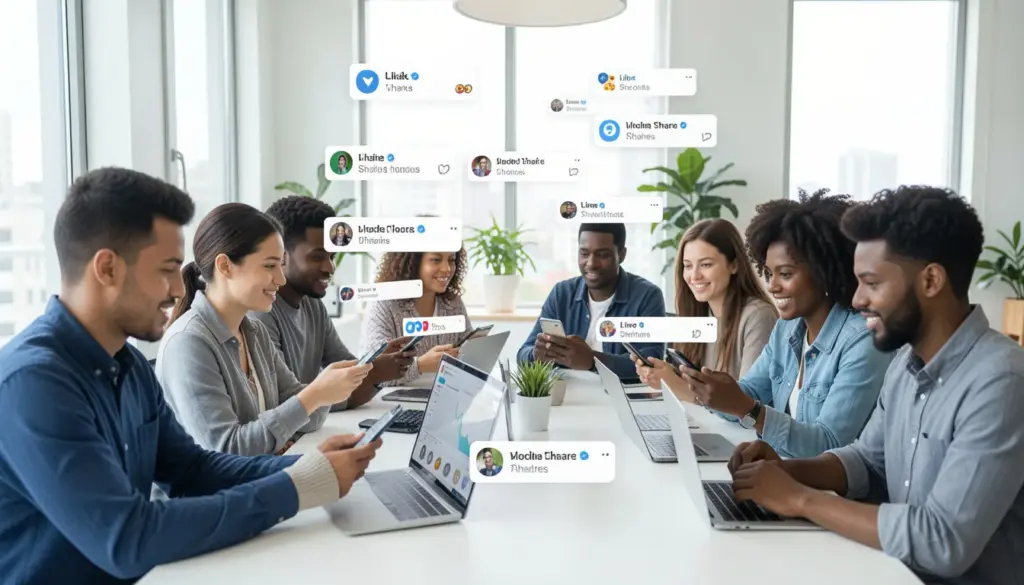
Scroll through any social media feed for ten minutes, and you’ll encounter opinions — about politics, culture, science, and society — presented with the confidence of fact. What appears to be an organic exchange of ideas is, in reality, shaped by a complex web of algorithms, platform design choices, and social dynamics that most users never see.
Understanding how social media influences public opinion isn’t just an academic exercise. It affects how elections unfold, how social movements gain traction, and how entire communities come to share — or contest — a common view of the world. This article breaks down the core mechanisms at work, examines real consequences, and offers a framework for thinking more critically about what you encounter online.
Mechanisms of Influence: How Platforms Shape What We Believe
Social media doesn’t simply reflect public opinion — it actively participates in constructing it. The process works through several interlocking mechanisms.
Algorithmic curation is the starting point. Platforms like Facebook, TikTok, and YouTube use machine learning systems to determine which content appears in a user’s feed. These systems are built to maximize engagement — the time spent, the clicks made, the reactions triggered. Content that provokes strong emotional responses (outrage, excitement, fear) tends to generate higher engagement metrics, so the algorithm promotes it more aggressively. The result is that emotionally charged content reaches wider audiences not because it’s accurate, but because it’s engaging.
Virality amplifies this effect. When a post spreads rapidly — shared by thousands before fact-checkers can respond — it creates the impression of consensus. People are social creatures, and repeated exposure to a particular viewpoint signals that “everyone thinks this.” This phenomenon, sometimes called the bandwagon effect, can shift public sentiment on issues ranging from product boycotts to policy positions.
Echo chambers form when algorithms and user behavior combine. Because platforms serve content that aligns with a user’s existing preferences and engagement history, over time, most people find themselves in digital environments where their existing beliefs are consistently reinforced. Dissenting perspectives either don’t appear or are drowned out. This isn’t neutral — it gradually pulls users toward more extreme versions of views they already hold, a process researchers refer to as belief reinforcement through selective exposure.
Social influence theory offers a useful lens here. People don’t form opinions in isolation; they look to others — especially those they trust or identify with — as reference points. When social networks make certain opinions appear widespread and normal, they change the perceived social environment in which individual beliefs are formed.
Political and Social Implications
The political effects of social media on public opinion are among the most studied and debated aspects of the digital age. Campaigns, governments, and activist groups have all developed strategies that treat social platforms as primary arenas for shaping public sentiment.
Political campaigns now treat social media as essential infrastructure. During election cycles, targeted advertising allows campaigns to serve tailored messages to specific voter segments based on demographics, location, and behavioral data. This micro-targeting capability means different groups of voters may encounter fundamentally different narratives about the same candidate or policy — a fragmentation of the shared information environment that makes it harder to build genuine public consensus.
The role of social media in elections extends beyond advertising. Organic content — posts, memes, videos created and shared by ordinary users — can shift how candidates are perceived. A single viral clip can redefine a politician’s public image within hours, regardless of whether the clip accurately represents the full context.
Beyond electoral politics, social media has reshaped social movements and activism. The Arab Spring, the #MeToo movement, and climate activism all gained international visibility through platforms like Twitter and Instagram. Digital activism enables rapid organization and broadens the reach of movements that might previously have remained local. However, critics note that online support doesn’t always translate into sustained real-world action — a phenomenon sometimes called slacktivism, where the act of sharing or liking a post substitutes for deeper engagement.
Social media’s influence on societal norms is subtler but equally significant. When certain behaviors, attitudes, or lifestyles become consistently visible and positively reinforced on platforms, they gradually shift what people perceive as acceptable or desirable. This is particularly visible in areas like body image, consumption habits, and political identity.
Misinformation, Fake News, and Echo Chambers
No analysis of social media and public opinion is complete without addressing misinformation. The structural features that make platforms effective at spreading ideas also make them effective at spreading false ones.
Information diffusion on social networks is fast and largely unfiltered. A fabricated story can accumulate millions of shares before a credible correction gains any traction. Research from MIT found that false news spreads significantly faster on Twitter than accurate news — and that human users, not automated bots, are primarily responsible for this spread. The emotional charge of false stories (which tend to be more novel and surprising) may explain why people share them so readily.
Misinformation takes several forms. Some is deliberate — disinformation created and spread with the specific intent to deceive. Some is accidental, arising from misunderstood studies, stripped-of-context clips, or well-intentioned but factually incorrect posts. Both types can have real consequences. During health crises, vaccine misinformation has demonstrably reduced uptake of protective measures. During elections, false narratives about voting procedures have suppressed participation.
Echo chambers compound the problem. When a piece of misinformation circulates within a closed information network, it rarely encounters challenge. Members of the network assume the claim is credible because multiple trusted sources — all of whom actually heard it from the same original post — appear to confirm it. This is the illusory truth effect in digital form: repetition breeds perceived credibility.
Algorithmic bias plays a direct role. Platforms don’t intentionally promote false content, but their engagement-driven systems don’t reliably penalize it either. Content that generates strong reactions — which misinformation often does — is amplified regardless of its accuracy. Some platforms have implemented fact-checking labels and reduced the algorithmic distribution of flagged content, but these measures remain incomplete and contested.
Case Studies: When Social Media Moved Public Opinion
Abstract mechanisms become clearer through concrete examples. The following cases illustrate how platforms have shaped public perception in measurable ways.
The 2016 U.S. Presidential Election drew widespread scrutiny regarding the role of social media in opinion formation. Investigations revealed coordinated campaigns — both domestic and foreign — that used Facebook, Twitter, and YouTube to spread divisive content and targeted political advertising. A U.S. Senate Intelligence Committee report documented how operatives used social network targeting to reach specific demographic groups with tailored narratives. The scale of this activity raised fundamental questions about platform accountability and the integrity of digitally mediated political discourse.
The #MeToo movement demonstrates social media’s capacity to shift cultural opinion rapidly. Beginning in 2017, allegations shared on Twitter with the hashtag #MeToo created a networked space where individual accounts of harassment and assault became collectively visible. The cumulative weight of these shared experiences shifted public opinion on workplace conduct, legal accountability, and power dynamics within institutions — changes that have persisted well beyond the initial wave of online activity.
COVID-19 misinformation offers a sobering case study in the dangers of uncontrolled information diffusion. False claims about the virus’s origins, severity, and treatments spread across Facebook, YouTube, and WhatsApp at a pace that consistently outran fact-checkers. The World Health Organization described the simultaneous spread of disease and misinformation as an “infodemic.” Public health authorities reported measurable impacts on behavior — including vaccine hesitancy — that were traced back to social media exposure.
TikTok and political awareness among younger audiences represent a newer pattern. Short-form video content on TikTok has become a significant source of political information for users under 30. This shift matters because TikTok’s recommendation algorithm operates differently from older platforms — it serves content based on viewing behavior rather than social connections, which means users are more likely to encounter perspectives outside their immediate social circle. Whether this reduces echo chamber effects or simply creates new ones is an active area of research.
Comparing Platforms: Not All Social Networks Influence the Same Way
Different platforms create different information environments, and their effects on public opinion vary accordingly.
Facebook’s social graph model — built around connections to friends, family, and acquaintances — tends to reinforce existing social norms. Political content on Facebook often travels along trust networks, giving it heightened credibility. Facebook’s scale (billions of active users) means even small shifts in engagement patterns can have population-level effects on opinion formation.
Twitter (X) functions more as a public discourse space. Politicians, journalists, academics, and public figures use it to communicate directly with large audiences. Twitter’s open architecture means conversations are more visible across social boundaries, but it also concentrates influence in the hands of high-follower accounts. A single post from a prominent account can set the agenda for mainstream media coverage — a dynamic researchers call platform-to-press agenda setting.
YouTube’s long-form format allows for more detailed presentation of ideas, which can support genuine understanding — but also sophisticated misinformation. The platform’s recommendation engine has been documented, leading users from mainstream content toward progressively more extreme material, a pathway sometimes described as the rabbit hole effect.
Instagram and TikTok rely heavily on visual and emotional content, which shapes opinion more through affect than argument. Aspirational content, influencer endorsements, and aesthetic framing all contribute to how audiences perceive social and political issues — particularly among younger users for whom these platforms are primary news sources.
Critical Evaluation Strategies: Reading Social Media More Carefully
Understanding how social media shapes public opinion is only useful if it informs how we engage with it. The following framework is useful for students, researchers, and anyone seeking to assess online information critically.
Check the source before you share. Who created this content? Does the account or publication have a verifiable track record? A viral post from an anonymous account warrants more scrutiny than one from a named journalist at a credentialed outlet.
Consider why you’re inclined to believe it. Confirmation bias — the tendency to accept information that aligns with existing beliefs — is one of the most powerful forces in opinion formation. If a claim feels obviously true because it confirms something you already think, that’s a reason to investigate further, not less.
Look for corroboration from independent sources. Genuine news is typically reported across multiple outlets with independent reporting. A claim that exists only on a single platform, or is only shared within a specific ideological community, should be treated with caution.
Understand the algorithmic context. The content you see is not a representative sample of all available information. It has been filtered and ranked according to engagement logic. Actively seek out perspectives outside your typical feed to get a more complete picture of how different communities understand the same events.
Distinguish between opinion and evidence. Social media compresses the distinction between argument and assertion. A confident, well-formatted post is not the same as a supported claim. Ask what evidence underlies the opinion being expressed.
Media literacy — the ability to analyze, evaluate, and create information across media formats — is the foundational skill for navigating social networks as a consumer of ideas rather than a passive subject of them.
Final Thoughts
Social media has fundamentally changed the landscape of public opinion formation. The mechanisms involved — algorithmic curation, virality, echo chambers, targeted political messaging, and the rapid spread of misinformation — are not incidental features. They are structural properties of platforms designed primarily to capture and hold attention.
This doesn’t mean social media is simply harmful. Digital activism has amplified voices that were previously excluded from public discourse. Platforms have created spaces for community, solidarity, and the rapid organization of social change. The same network effects that spread misinformation also spread accurate information, corrections, and critical analysis.
What it means is that the relationship between social media and public opinion is neither passive nor neutral. The platforms shape what we see, what we’re likely to believe, and what ideas feel socially acceptable. Recognizing those dynamics is the first step toward engaging with them deliberately rather than being swept along by them.
For students and researchers, the study of social media and public opinion sits at the intersection of communication theory, political science, psychology, and data science. It’s a field that will only grow in importance as digital platforms continue to expand their role in public life. The core question — how do shared beliefs form in a networked world? — is one of the defining questions of contemporary society.