

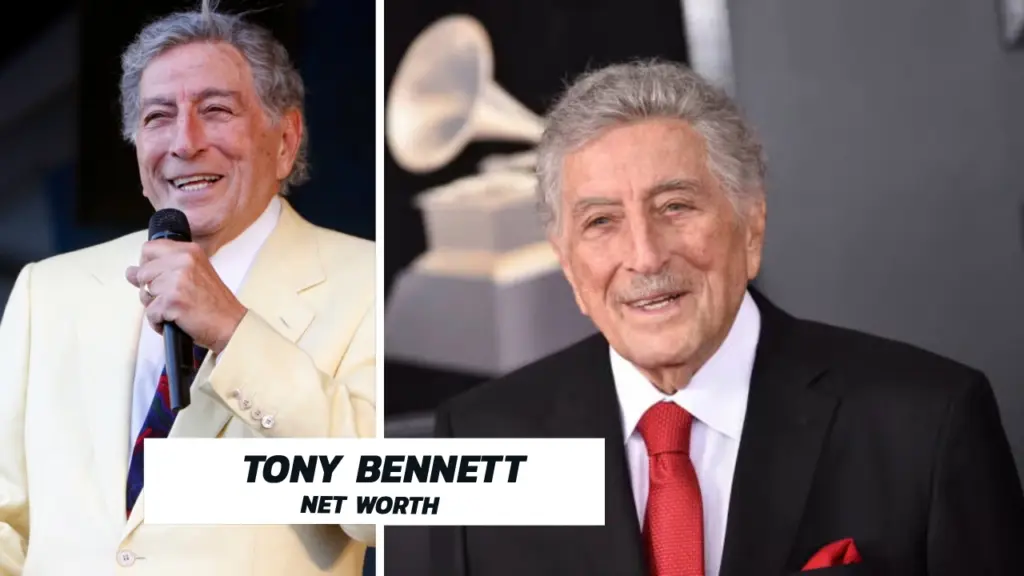
At the time of his death on July 21, 2023, Tony Bennett had an estimated net worth of $200 million. That figure represents one of the most unlikely wealth stories in American music — a career that collapsed under drug addiction and industry neglect, then came back so completely that Bennett was still breaking Billboard records at age 95.
This article covers every major source of his wealth, how his finances nearly fell apart in the 1970s, how his son rebuilt them in the 1980s, and what happened to his estate after his death.
Who Was Tony Bennett?
Anthony Dominick Benedetto was born on August 3, 1926, in Queens, New York. His father, a grocer who had emigrated from Reggio Calabria in southern Italy, died when Tony was ten years old. The family was poor throughout the Great Depression, and Tony left school at 16 to support them.
He worked as a singing waiter in Italian restaurants around Queens and spent his teenage years performing at amateur nights across the city. At 13, he was already earning tips with his voice. His path into serious music began when Pearl Bailey invited him to open for her in Greenwich Village in 1949. Bob Hope attended that show, brought Bennett on tour, and shortened the stage name he used — Joe Bari — to Tony Bennett.
In 1950, Bennett was signed to Columbia Records by producer Mitch Miller. What followed was one of the most commercially successful decades in pop music history.
The Early Career That Built the Foundation
Between 1951 and 1965, Tony Bennett built the financial and artistic base that would support his entire life.
His first hit, “Because of You,” reached number one on the pop charts in 1951 and stayed there for ten weeks, selling over a million copies. “Rags to Riches” topped the charts for eight weeks in 1953. “Stranger in Paradise” hit number one in the United Kingdom the following year. By the early 1960s, Bennett had placed more than a dozen songs in the Billboard Top 40.
The defining financial moment of this period came in 1962, when “I Left My Heart in San Francisco” earned him Grammy Awards for Record of the Year and Best Male Solo Vocal Performance. Both the single and the album achieved gold status. The song became his signature — in 2001, the RIAA ranked it among the most historically significant songs of the 20th century — and it generated royalty income for the rest of his life.
That same year, Bennett staged a sold-out concert at Carnegie Hall featuring 44 songs. He was among the first male pop performers to headline the venue, and the performance was recorded, adding another revenue stream.
By his mid-thirties, Tony Bennett was a wealthy man. The problem was what came next.
Financial Collapse: The 1970s
The British Invasion of 1964 and the rise of rock and roll created serious commercial problems for traditional pop and jazz singers. Bennett’s chart presence faded steadily after 1965. Columbia Records pushed him to record contemporary rock material, which he later said made him physically ill. The label-mandated album Tony Sings the Great Hits of Today! (1970) pleased neither critics nor fans, and by 1972, Bennett had left Columbia.
He signed with MGM/Verve, launched his own label called Improv, and released two well-regarded jazz albums with pianist Bill Evans. But without major distribution, Improv collapsed by 1977.
By the late 1970s, the situation was dire. Bennett had developed a cocaine addiction, was living beyond his means, had no recording contract, and owed significant back taxes to the IRS — enough that the agency moved to seize his Los Angeles home. His Las Vegas residency circuit, once a reliable income source, now carried the stigma of a declining career.
In 1979, following a near-fatal overdose, Bennett called his sons Danny and Dae for help. It was one of the most consequential phone calls in music history.
The Comeback and Wealth Rebuild: 1980s–1990s
Danny Bennett had been playing in a band that hadn’t worked out. He recognized that his father had extraordinary talent but no financial discipline — and that he himself had no musical talent but a real mind for business. He became Tony’s manager.
The strategy Danny built was deliberate and counterintuitive. Instead of chasing trends, he stripped everything back. He controlled Tony’s spending, moved him back to New York, booked him in college venues and small theaters to create distance from the Las Vegas image, and eventually negotiated an IRS repayment plan.
By 1986, Bennett re-signed with Columbia Records — this time with full creative control — and released The Art of Excellence, his first album to chart since 1972.
The key financial breakthrough, however, came in 1994. Danny secured Tony a spot on MTV Unplugged, a platform that reached an entirely new generation. The resulting album went platinum, won Album of the Year at the Grammy Awards, and Best Traditional Pop Vocal Performance for the third consecutive year. Bennett was 68 years old.
By 1999, his assets were valued at $15 to $20 million, and he was performing approximately 100 shows per year. From near bankruptcy to a $15–20 million asset base in less than two decades — that trajectory is the core of his financial story.
Peak Earnings: 2000s and Beyond
The 21st century was the most financially rewarding period of Bennett’s career. He recorded steadily, toured globally, and accumulated Grammy Awards — eventually winning 20 in total, along with a Grammy Lifetime Achievement Award, two Primetime Emmy Awards, a Kennedy Center Honor, and a star on the Hollywood Walk of Fame.
His Duets: An American Classic (2006) album hit his highest-ever chart position. His collaboration with Lady Gaga on Cheek to Cheek (2014) debuted at number one on the Billboard charts, making Bennett the oldest living artist to reach that position at the time — at 88 years old. The album won a Grammy and generated significant touring revenue.
Their second collaborative album, Love for Sale (2021), broke the record for the longest span of top-10 albums on the Billboard 200 by any living artist — stretching back to I Left My Heart in San Francisco in 1962. It also earned Bennett the Guinness World Record for the oldest person to release an album of new material, at 95 years and 60 days.
These records weren’t just cultural milestones. They were commercial events. Each one extended his touring contract value and streaming presence at an age when most artists have been forgotten.
Tony Bennett’s Multiple Income Streams
What separated Bennett’s wealth from that of typical musicians of his era was the range of his income sources.
Music Royalties and Recording Contracts
With over 50 million records sold worldwide and a catalog spanning seven decades, Bennett’s royalty income was continuous. The recurring airplay and streaming of songs like “I Left My Heart in San Francisco,” “Because of You,” and “Rags to Riches” generated passive income every year. His average annual earnings were estimated at around $4 million at the height of his career.
Concert Revenue
For much of his career, Bennett performed approximately 100 shows per year. High-profile engagements — Carnegie Hall, international tours with Lady Gaga, benefit concerts, and television specials — carried premium fees. His 2021 Radio City Music Hall shows with Lady Gaga, which served as his final performances, were major commercial events.
Painting Sales
Under his birth name, Anthony Benedetto, Bennett was a recognized fine arts painter whose work appeared in galleries around the world. Some of his pieces sold for as much as $80,000. This was not a hobby income — it was a genuine secondary career that contributed meaningfully to his wealth.
Real Estate
For many years, Bennett owned a sprawling mansion in Belvedere, Marin County, California — an 8,600-square-foot, seven-bedroom property with views of San Francisco Bay. He listed it in 2010 for $27.5 million. The sale took five years and multiple price reductions, eventually closing in September 2015 at $15.5 million. He also maintained an apartment in New York City overlooking Central Park.
Television and Media
Bennett earned Emmy Awards for his television work, including the special Tony Bennett: An American Classic (2006) and his A&E Live by Request performance. Royalties from televised specials and licensed recordings added further passive income.
Tony Bennett’s Net Worth vs. the Estate Dispute
One important distinction that most coverage conflates is the difference between Tony Bennett’s estimated net worth and the value of his formal estate at the time of death.
The widely cited $200 million figure refers to his lifetime accumulated net worth — the total value of assets, earnings, and income streams built across 70-plus years. This is the number that appears in biographical profiles.
Following his death, however, a separate legal matter emerged involving his children and the management of his estate. Some reports placed the estate value at approximately $7 million, which is a very different number. The distinction matters: the $7 million figure likely reflects only the assets directly accessible through probate — tangible property and liquid holdings — not the broader estimate of everything he had earned and distributed over his lifetime. Significant wealth is often held in trusts, transferred before death, or tied up in ongoing royalty streams rather than sitting in a single estate account.
The legal dispute involved his four children disagreeing about how the estate was being managed, not about the total size of what he had earned during his life.
Family and Inheritance
Tony Bennett was married three times and had four children.
His first wife, Patricia Beech, whom he married in 1952, gave him two sons: D’Andrea (Danny) and Daegal (Dae). That marriage ended in 1971. His second wife, Sandra Grant, whom he married in 1971, gave him two daughters: Joanna and Antonia. They separated in 1979, and the divorce was finalized in 1983. In 2007, Bennett married Susan Crow, a philanthropist 40 years his junior. She was with him until his death.
He also had nine grandchildren.
His children were deeply involved in his professional life. Danny served as his manager for decades, credited by Tony himself as the person who rescued his career and finances. Dae is a recording engineer who worked on several of his father’s projects. Antonia is a jazz singer who opened many of her father’s concerts. Joanna kept a lower public profile.
Bennett’s wife, Susan Crow, has a net worth estimated independently at between $1 million and $110 million, though the relationship between her finances and Tony’s estate is not publicly confirmed.
Because Bennett was diagnosed with Alzheimer’s disease in 2016 — five years before his death — and continued to perform and record until 2021, his family had time to plan for estate management. The assumption is that proper legal structures, including trusts and a will, were in place well before his death.
Legacy Beyond the Numbers
Tony Bennett’s net worth of $200 million is not just a financial figure. It is the product of a career that collapsed completely and was rebuilt from scratch — without changing his style, his material, or his standards.
He founded the Frank Sinatra School of the Arts in Astoria, Queens, a free public high school that continues to operate today. He supported civil rights causes throughout his life, participating in the 1965 Selma-to-Montgomery marches. He was widely known for his charitable work, earning the informal nickname “Tony Benefit.”
He sang without a microphone on stage into his eighties. He recorded a Grammy-winning album at 95. He broke Billboard records that will likely never be broken again, simply by continuing to create at the highest level for longer than anyone else had.
The money followed the craft. That, more than any contract or investment, is the real lesson of Tony Bennett’s net worth.