

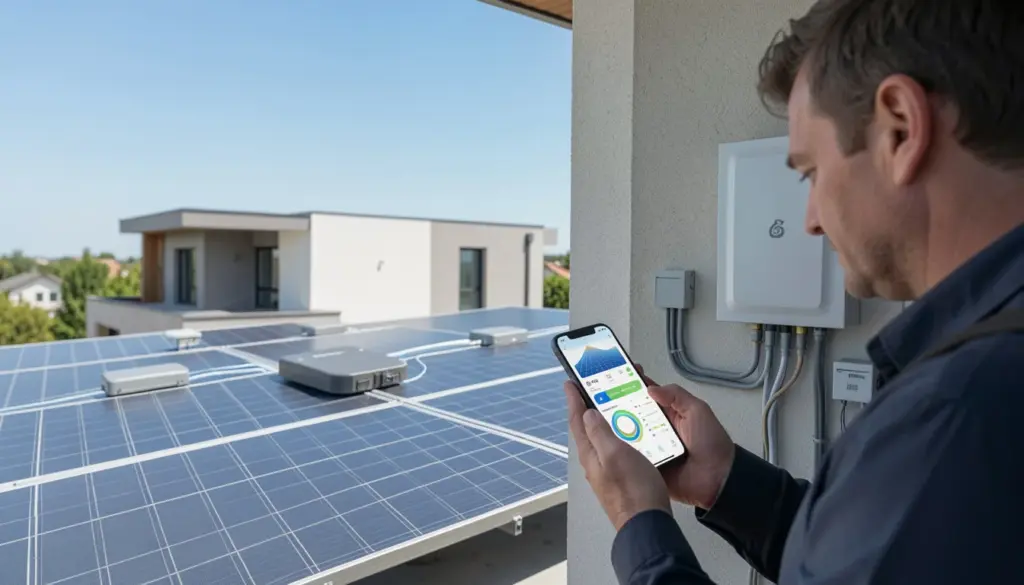
HMS Photovoltaik refers to a category of intelligent photovoltaic systems that combine solar power generation with advanced energy management, panel-level monitoring, and — in many configurations — battery storage. Unlike conventional solar setups, where panels feed electricity into the grid passively, HMS systems actively manage how energy is produced, stored, consumed, and shared.
The term is most closely associated with the Hoymiles HMS microinverter product line. It is also used broadly to describe Hybrid or High-Management System photovoltaics — a smarter generation of solar technology designed for modern homes, businesses, and energy-conscious users worldwide.
What Is HMS Photovoltaik?
At its core, HMS Photovoltaik is solar energy with intelligence built in.
The term describes the next evolution of solar energy systems: intelligent, hybrid photovoltaic solutions that merge electricity generation, energy storage, and smart monitoring into a single framework. Rather than simply producing electricity and exporting the surplus, these systems track what is being generated, analyze consumption patterns, and make real-time decisions about where that energy goes.
Instead of producing energy blindly, the system knows what it is doing — and more importantly, so do you. This visibility is one of the most significant differences between HMS photovoltaics and older, passive solar installations.
The Two Meanings of “HMS” in Solar Energy
It is worth clarifying a common source of confusion. “HMS Photovoltaik” is used in two distinct but related ways:
1. Hoymiles HMS Series (specific product line)
The “HMS” in HMS Photovoltaik often refers to the latest generation of microinverters from Hoymiles, such as the Hoymiles HMS series, which are engineered for high-power modules — devices designed to handle the increasing wattage of modern PV panels, which now frequently exceed 500W or even 600W.
2. Hybrid/High-Management System PV (broader concept)
HMS Photovoltaik stands for Hybrid or High-Management System photovoltaics — a term that combines solar generation with intelligent control and storage. The “hybrid” aspect reflects the ability to operate both grid-tied and off-grid, while the “management” aspect emphasizes the role of software-driven energy management.
Both interpretations share the same principle: solar energy is no longer just generated — it is actively managed.
How HMS Photovoltaik Works
Understanding how HMS systems function requires looking at three key technical mechanisms that work together continuously.
DC-to-AC Conversion at the Panel Level
Traditional solar arrays are typically “string” systems, where multiple panels are linked together. HMS Photovoltaik uses a decentralized approach — a small, sophisticated microinverter is attached to each solar panel (or pairs of panels), allowing each unit to operate independently.
This is a fundamental architectural shift. In a string system, shading or a fault on one panel reduces the output of the entire string. With an HMS microinverter setup, each panel is its own conversion unit. If a cloud passes over one corner of your roof, only the affected panels see a dip in production, while the rest of the system continues to generate electricity at full capacity.
With an HMS setup, the conversion from DC to AC happens right at the panel. The electricity traveling through your attic and into your walls is the same safe AC power used by your household appliances. This eliminates the high-voltage DC wiring risks associated with traditional string inverters.
Panel-Level MPPT
Every solar panel has a constantly shifting “sweet spot” — its Maximum Power Point — where it produces the most electricity given current light and temperature conditions. HMS Photovoltaik systems feature independent MPPT for each input. This means the system is constantly tuning each panel individually to ensure it is always operating at peak efficiency, regardless of what is happening to the neighboring panel.
This per-panel optimization is the core of why HMS systems consistently outperform string inverter setups in real-world conditions.
Sub-1G Wireless Communication
Many traditional systems utilize Power Line Communication or standard Zigbee, which could be prone to interference. Modern HMS Photovoltaik solutions often employ Sub-1G wireless technology. This allows for more stable, long-range communication between the microinverters on the roof and the gateway (DTU) inside the building, even in complex industrial environments.
Sub-1G technology is particularly useful for PV microinverters and is different from 2.4GHz in that it has a substantially longer range and better interference suppression performance. This stability is what makes real-time monitoring reliable rather than intermittent.
Core Components of an HMS Photovoltaic System
A complete HMS Photovoltaik installation is made up of several specialized components that work together:
1. Microinverters
Microinverters are the foundation. Unlike string inverters used in traditional solar setups, HMS systems rely on microinverters mounted behind each solar module, allowing independent operation of each panel and reducing the impact of shading, dirt, or malfunction. The Hoymiles HMS lineup spans 1-in-1 (single panel), 2-in-1 (dual panel), and 4-in-1 (quad panel) configurations, with power ratings from 400W to 2000W per unit.
2. DTU Gateway (Data Transfer Unit)
DTU Gateway (Data Transfer Unit) collects performance data from every microinverter via Sub-1G wireless and sends it to the cloud platform. Microinverter data is collected by the DTU via wireless transmission and sent to the Hoymiles monitoring platform, S-Miles Cloud.
3. S-Miles Cloud
S-Miles Cloud is the software layer. Each panel transmits data to a central gateway that connects to a cloud-based platform, allowing real-time performance analytics and remote system control. Users access this via mobile or desktop to view live generation data, panel-level faults, and historical trends.
4. Battery Storage
Battery Storage is an optional but increasingly common addition. HMS Photovoltaik integrates modern lithium-based batteries to store excess energy, ensuring a constant and uninterrupted power supply.
5. AC Trunk Cable System
AC Trunk Cable System connects microinverters to the distribution board. The HMS Trunk Connector solution includes a new trunk connector, an extension cable connector, a disconnect tool, and more — with ready-made components designed to significantly reduce installation time.
Types of HMS Solar Systems
HMS Photovoltaik is not a single product but a family of configurations:
- Grid-Tied Systems are the most common for residential users. The installation connects directly to the utility grid, allowing homeowners to export surplus energy and draw from the grid when generation falls short. These offer the fastest financial payback through net metering arrangements.
- Off-Grid Systems operate entirely independently of utility infrastructure. Ideal for remote locations, they rely on battery storage solutions to ensure a reliable power supply even during outages or cloudy days.
- Hybrid Systems combine both approaches. This flexibility allows users to store energy while still benefiting from the main electricity grid when necessary. Hybrid configurations are particularly suited to areas with unstable grid supply or time-of-use electricity tariffs.
- Building-Integrated Photovoltaics (BIPV) are a growing niche where HMS technology is embedded directly into roofing or facade materials, generating power without traditional panel mounting.
HMS Photovoltaik vs. Traditional String Inverter Systems
This is where HMS systems demonstrate their clearest advantages — and their trade-offs.
| Feature | HMS Microinverter System | String Inverter System |
|---|---|---|
| Conversion point | Per panel | Centralized |
| Shading impact | Minimal (panel-level) | Significant (whole string) |
| MPPT | Per panel | Per string |
| Monitoring granularity | Panel-level, real-time | System-level only |
| Safety (DC voltage) | Low DC at panel (<60V) | High DC wiring on the roof |
| Rapid shutdown compliance | Inherent | Requires add-ons |
| Scalability | Modular (add panels easily) | Limited by the inverter size |
| Installation complexity | Slightly more hardware | Simpler wiring |
| Self-consumption rate | Up to 70–90% with EMS | Typically 30–40% |
| Upfront cost | Higher | Lower |
| Failure risk | One unit fails, the rest work | Central failure = system down |
By coordinating components, HMS systems achieve higher system efficiency, often raising self-consumption rates from 30–40% to 70–90%. For households with complex roof shapes, partial shading, or multiple roof orientations, this difference is substantial.
Real Benefits of HMS Photovoltaik
The advantages of HMS systems extend well beyond raw efficiency numbers.
Energy independence is the most valued benefit for homeowners. HMS Photovoltaik systems analyze usage patterns and adjust energy flow automatically. Power gets used where it makes the most sense — stored when it is valuable, consumed when it is efficient, and exported only when beneficial.
Safety is a compelling, underappreciated advantage. HMS Photovoltaik generally operates on a low DC voltage (mostly less than 60V) at the module level. This eliminates the risk of fire hazards, short circuits, and electrical shocks effectively. Furthermore, these systems inherently comply with rapid shutdown requirements, allowing first responders to de-energize the roof instantly in case of an emergency.
Scalability removes one of the traditional barriers to solar adoption. HMS Photovoltaik systems grow with you. Today, you can start with a small unit and plan further according to capacity. The system architecture supports gradual upgrades without forcing a full redesign.
Predictive maintenance through the cloud platform means issues are flagged before they become costly. Using AI and historical data, the system can alert users about potential issues before they become critical, reducing downtime and service costs.
Financial returns are also meaningful. Within the first year, a mid-sized manufacturing plant that installed an HMS solar system reported a 30% reduction in electricity bills. Government incentives and feed-in tariffs strengthen the return further in many markets.
Limitations and Challenges
No technology is without trade-offs, and honesty here is essential for EEAT credibility.
Higher upfront cost is the most significant barrier. HMS microinverter systems typically cost more per watt than equivalent string inverter installations because each panel requires its own hardware unit.
More physical components mean more potential points of failure over time — though each failure is isolated and rarely affects the rest of the system.
Monitoring dependency means that without a functioning DTU gateway and internet connection, cloud monitoring becomes unavailable. Offline fallback monitoring should always be confirmed with the installer.
Installation complexity is marginally higher, and installers must ensure there is adequate space (typically at least 2cm) beneath the module for air circulation. Proper ventilation prevents the microinverter from overheating, which extends its lifespan. This makes professional installation strongly advisable over DIY approaches.
How an HMS PV System Is Installed
A professional HMS Photovoltaik installation follows a structured workflow:
Step 1 — Site Assessment & Layout Planning Map the roof area, identify shading sources, measure available surface, and determine which microinverter configuration (1-in-1, 2-in-1, or 4-in-1) fits the planned panel count and wattage.
Step 2 — Mounting Rail Installation Fix aluminum mounting rails to the roof structure at the correct pitch and spacing, ensuring structural integrity for long-term load-bearing.
Step 3 — Microinverter Placement Mark the position of each microinverter on the rail according to the PV module layout. Ensure each unit is positioned under — not exposed beside — the panel, to protect against direct sunlight, rain, UV, and snow buildup.
Step 4 — AC Trunk Cable Assembly Select the appropriate AC Trunk Cable according to the spacing between microinverters. Determine how many microinverters you plan to install on each AC branch and prepare AC Trunk Connectors accordingly.
Step 5 — Panel Installation & DC Connection Mount solar modules onto rails and connect each panel’s DC output cable to its corresponding microinverter. Verify polarity before securing.
Step 6 — AC Connection to Distribution Board Run the AC trunk cable from the roof array into the building’s distribution board, ensuring the installation complies with local grid connection regulations and standards.
Step 7 — DTU Gateway Setup Install the DTU gateway inside the building and pair it with the microinverters. Microinverter data is collected by DTU via wireless transmission and sent to the Hoymiles monitoring platform S-Miles Cloud. Register the system on the cloud platform.
Step 8 — Commissioning & Monitoring Verification Power up the system, check all panels report correctly on the monitoring dashboard, confirm generation figures appear live, and verify no fault indicators are present.
Common Mistakes to Avoid
Even well-planned installations can go wrong. These are the most frequently observed errors:
- Skipping ventilation clearance: Not leaving the minimum 2cm gap under each microinverter leads to thermal throttling and premature hardware failure.
- Mismatched panel wattage: The output DC power of a PV module should not exceed 1.35 times the output AC power of the corresponding microinverter — violating this risks equipment damage.
- Incorrect DTU pairing: Failing to register all microinverter serial numbers in the DTU results in incomplete monitoring and invisible underperforming panels.
- Ignoring local grid regulations: Connecting HMS systems to the grid without proper utility notification or compliance documentation can void warranties and create legal liability.
- Over-stringing on a single AC branch: The number of microinverters per branch is limited by cable ampacity. Exceeding this limit is a serious electrical safety risk.
- Bypassing professional installation: Despite the modular design, HMS systems require qualified technicians for safe commissioning and grid connection.
Conclusion
HMS Photovoltaik represents a genuine step forward from conventional solar installations — not because it uses fundamentally different materials, but because it brings intelligence to a system that was previously passive. Whether understood as the Hoymiles HMS microinverter product line or the broader concept of Hybrid Management System photovoltaics, the defining characteristics are the same: per-panel independence, real-time visibility, active energy management, and the ability to grow with your energy needs over time.
For anyone evaluating solar today — whether for a home, a business, or a larger project — the key questions are not just about panel wattage or cost per kilowatt-hour. They are about how much control you want over your energy, how your roof is shaped, and how complex your consumption patterns are. Where the answer to any of those involves nuance, HMS Photovoltaik is worth a serious look.
All technical specifications referenced reflect publicly available documentation from Hoymiles Power Electronics. System performance figures vary based on location, installation quality, and usage patterns. Always consult a qualified installer before specifying or purchasing any photovoltaic system.