

You know you should exercise. You’ve probably told yourself you’ll start on Monday — or after this week — or when things slow down. But the motivation never quite shows up, and the gap between knowing and doing keeps getting wider.
Here’s what nobody tells you: waiting for motivation is the wrong strategy. Motivation is unreliable. It comes and goes based on how much sleep you got, how stressful your day was, and a dozen other things outside your control. The people who actually stick to exercise long-term aren’t more motivated than you — they’ve just built a system that doesn’t depend on it.
This guide gives you a clear, step-by-step framework to start exercising from zero. No gym required. No hour-long sessions. No unrealistic expectations. Just a practical 21-day approach designed around how habits actually form.
Why You Have No Motivation to Exercise
Before jumping into what to do, it helps to understand why starting feels so hard. The resistance you feel isn’t laziness — it’s psychology.
When you think about exercising, your brain doesn’t just think about the workout. It calculates the effort, the discomfort, the time, and compares all of that to the reward — which feels distant and uncertain. Meanwhile, sitting on the couch offers an immediate, guaranteed payoff. Dopamine, the brain chemical tied to reward and motivation, responds to instant gratification far more strongly than to future benefits.
Add to this the pressure of unrealistic expectations — the idea that a “real” workout means waking up at 5 am, going to the gym five days a week, and transforming your body in 30 days — and it’s no surprise most people freeze before they even begin. Overwhelm is the single biggest reason beginners quit before they start.
The good news is that once you understand this pattern, you can work around it rather than fight it.
Motivation vs Discipline: What Actually Works
Motivation is an emotion. Like all emotions, it fluctuates. Some mornings you’ll feel genuinely excited to work out. Most mornings, you won’t. If your exercise habit depends on feeling motivated, it will collapse within two weeks — which is exactly what happens to most people.
Discipline, on the other hand, is behavior. It’s showing up whether you feel like it or not, because you’ve decided in advance. But discipline doesn’t mean forcing yourself through misery. It means designing your environment and schedule so that exercising becomes the easiest, most obvious choice available.
The most reliable approach combines both: build a system — a repeatable structure that reduces decision-making — and let the habit carry you on days when motivation is low. Over time, the habit itself generates momentum, and momentum starts to feel like motivation.
The “Start Small” Rule (Your Real Starting Point)
The most common beginner mistake is trying to do too much at once. An ambitious plan feels exciting on Day 1 and suffocating by Day 5.
The research on habit formation is consistent: small actions, repeated reliably, produce far better long-term results than large actions taken sporadically. This is the foundation of the micro habit approach.
Start with five minutes. Not five minutes as a warm-up to a longer session — just five minutes, done consistently every day. The goal in the first week isn’t fitness. It’s showing up. Every time you complete even a short session, you reinforce the identity of someone who exercises. That self-image becomes the real engine of long-term consistency.
Another useful concept is removing friction — making it as easy as possible to begin. Lay out your workout clothes the night before. Pick a time slot and protect it. Choose exercises that require no equipment and no travel. The fewer decisions you need to make before starting, the more likely you are to actually start.
Step-by-Step: Build Your Beginner Workout Routine
A good beginner workout routine doesn’t need to be complicated. In fact, simplicity is a feature — not a limitation. The goal is to create something you can repeat easily, even on low-energy days.
Here’s a simple structure that works for home workouts with no equipment:
Warm-up (2–3 minutes): March in place, arm circles, gentle hip rotations.
Main workout (10–15 minutes): Choose 3–4 exercises. Good beginner options include:
- Bodyweight squats
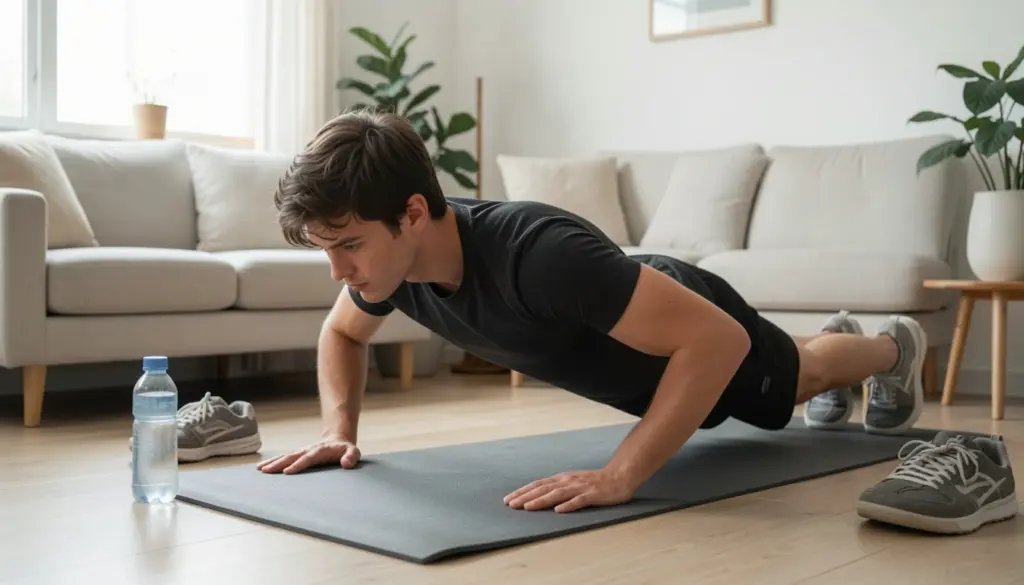
- Modified push-ups (knees on the floor if needed)
- Glute bridges
- Standing lunges
- Plank holds (start with 15–20 seconds)
Cool-down (2–3 minutes): Light stretching, deep breathing.
Total time: 15–20 minutes. That’s it. Three to four sessions per week, with rest days in between, is an entirely adequate starting point. You don’t need to go harder than this in the beginning. What matters is that you complete the sessions — not that you make them brutal.
As you get more comfortable, you can gradually increase the number of reps, reduce rest time between exercises, or add new movements. This gradual increase in challenge — known as progressive overload — is what produces real physical improvement over time. But in Week 1, just finish the workout.
The 21-Day Beginner Exercise Framework
Twenty-one days won’t make you fit. But it’s enough time to establish a habit, shift your self-perception, and make exercise feel like a natural part of your week rather than an interruption to it. Here’s how to structure the process.
Week 1 – Build the Habit (Consistency Focus)
Your only objective this week is to show up. Exercise 3 times (e.g., Monday, Wednesday, Friday). Sessions should be 10–15 minutes. Keep the intensity low. Don’t push through pain. Focus entirely on completing the session — not on how it feels or how many reps you hit.
Pick the same time every day. Morning works well for many beginners because there are fewer competing demands, but any consistent time slot is better than none. Habit triggers — specific cues that signal “it’s time to work out” — are what eventually make this automatic. Your time slot, your clothes laid out, your playlist — these become the cues your brain starts to associate with exercise.
Week 2 – Increase Engagement (Slight Progression)
You’ve shown up three times. Now add a fourth session and extend your workout to 15–20 minutes. Increase reps slightly or hold positions a few seconds longer. The physical challenge remains manageable, but you’re beginning to build real capacity.
This is also a good week to start tracking progress. A simple habit tracker — even a paper calendar where you cross off each completed workout — activates what behavioral psychologists call the “don’t break the chain” effect. Maintaining your streak becomes a small but real motivator on days when enthusiasm is low.
Week 3 – Strengthen Routine (Stability and Identity)
By now, exercise has a designated place in your week. This week, reinforce it. Keep your four sessions, maintain 15–20 minute duration, and experiment with slightly harder variations of the exercises you’ve been doing (e.g., full push-ups instead of modified, deeper squats).
The more important work this week is mental. Start thinking of yourself as someone who exercises — not someone who is trying to exercise. This shift from behavior-based thinking to identity-based thinking is, according to behavioral researchers like James Clear, one of the most powerful drivers of lasting habit change. Your workouts are no longer tasks you’re forcing yourself to do. They’re expressions of who you are.
How to Stay Consistent When Motivation Drops
There will be days — sometimes entire weeks — when you genuinely don’t feel like working out. This is not a sign that something is wrong. It’s normal, and it happens to everyone.
A few strategies hold up well during these periods:
Reduce the requirement. Tell yourself you only need to do five minutes. Often, once you start, you’ll continue. Even when you don’t, five minutes still count as showing up.
Use environmental design. Keep your workout space ready. If you work out at home, leave your mat on the floor. If you exercise at a park, keep your shoes near the door. Reducing the physical steps between you and starting makes the behavior more likely.
Habit stacking — attaching your workout to an existing routine — is another effective tool. “After I pour my morning coffee, I put on my workout clothes” creates a behavioral chain that, over time, becomes nearly automatic.
Reduce decision fatigue by pre-planning your workouts for the week on Sunday. When Monday arrives, there’s no deciding what to do — you just execute the plan.
Accountability Systems That Actually Work
Accountability is one of the most underrated components of building a fitness habit, and it’s what most beginner guides skip entirely.
A few practical approaches:
Progress tracking: Use a fitness app like MyFitnessPal or even a simple notes app to log each workout. Record what you did, how long, and how you felt. This data makes your progress visible, which your brain finds rewarding.
Workout reminders: Set a recurring phone alarm labeled with something specific — “10-minute workout” rather than just “exercise.” Specific cues are more effective than vague ones.
An accountability partner: Tell someone — a friend, a family member, a coworker — that you’re committing to a 21-day plan. Checking in with them after each session adds a layer of social accountability that’s surprisingly powerful. You don’t need someone doing the same routine. You just need someone who expects to hear that you did it.
Wearables like Fitbit can also be helpful for tracking movement, sleep, and activity patterns — but they’re optional. The simplest accountability system you’ll actually use is better than the most sophisticated one you’ll ignore.
Common Beginner Mistakes (And How to Avoid Them)
Starting too hard. The most common reason people quit is doing too much in the first week and burning out by Week 2. Match your starting intensity to your actual current fitness level — not where you think you should be.
Skipping rest days. Rest isn’t weakness. It’s when your body actually adapts and gets stronger. Schedule at least two to three rest days per week and treat them as part of the plan.
Expecting fast results. Physical changes take weeks to become visible. If you’re measuring success by how you look after two weeks, you’ll be disappointed. Measure success by whether you completed your sessions. That’s the only metric that matters early on.
All-or-nothing thinking. Missing one workout does not ruin your progress. The problem isn’t missing a day — it’s deciding the whole plan is ruined and stopping completely. One missed session means nothing. Get back on schedule the next day.
Comparing your beginning to someone else’s middle. The person next to you — online or at the gym — has been at this for months or years. Comparing yourself to them is like comparing your first week of driving to someone with ten years of experience.
How to Turn Exercise Into a Long-Term Habit
The 21-day plan is a starting point. The real goal is making exercise a permanent part of how you live — something that happens automatically, like brushing your teeth.
This happens through a combination of three things: repetition, identity, and integration.
Repetition reinforces the neural pathways associated with the habit. The more consistently you work out, the more automatic the behavior becomes. Identity shifts happen gradually as you accumulate evidence that you’re someone who exercises. Integration means fitting exercise into your actual life — not an imaginary version of it. Thirty-minute walks count. Ten-minute home sessions count. Movement you enjoy is more sustainable than movement you dread.
Think of fitness not as a program you complete, but as a lifestyle feature you’re gradually building in. Some weeks will be better than others. The goal isn’t perfection — it’s continuation. A sustainable routine you maintain for years will always outperform an intense program you abandon after a month.
FAQs
How long should beginners exercise each day?
Start with 10–20 minutes per session, three to four times per week. Duration and frequency matter less than consistency. Regular short sessions outperform occasional long ones for building habits.
Can I start exercising without going to the gym?
Absolutely. Bodyweight exercises — squats, push-ups, lunges, planks, glute bridges — provide a complete beginner workout with no equipment or gym membership needed.
What is the best time of day to exercise as a beginner?
The best time is the one you can maintain consistently. Many beginners find mornings easier because there are fewer distractions, but any fixed time that fits your schedule works.
How do I build an exercise habit from scratch?
Start extremely small (5–10 minutes), pick a consistent time, attach your workout to an existing routine, and track your sessions. Repeatability matters more than intensity at the start.
Why do I keep quitting exercise after a few days?
Usually, because the starting plan is too demanding or too vague. Reduce the difficulty, set a specific schedule, and give yourself a clear 3-week goal. Quitting is almost always a systems problem, not a willpower problem.
How do I stay consistent with workouts when life gets busy?
Have a minimum viable workout — a 5–10 minute version of your routine you can do on difficult days. Showing up briefly is always better than skipping. Protecting consistency matters more than maintaining intensity.