

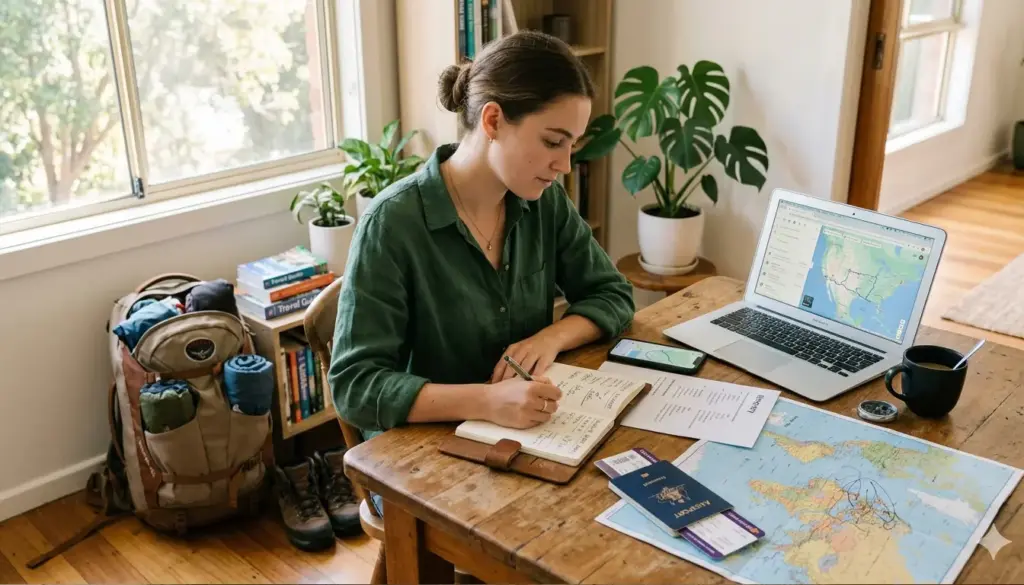
Most first backpacking trips don’t fall apart on the road — they fall apart before departure. Without a clear planning structure, it’s easy to book the wrong flights, underestimate costs, overpack, and arrive at a destination with no idea what comes next.
This guide walks you through every step of planning a backpacking trip from scratch. Whether you’re heading to Southeast Asia, Europe, or South America, the system here applies regardless of destination. By the end, you’ll have a workable itinerary, a realistic budget, a packing strategy, and the confidence to actually go.
Step 1 — Define Your Travel Goals and Destinations
Before opening a flight comparison tool, get clear on what kind of trip you want. This sounds obvious, but most beginner backpackers skip it and end up building a chaotic itinerary around random places they’ve heard of.
Start with a few simple questions. How long do you have? Are you interested in cities, nature, culture, or all three? Do you want a fast-paced multi-country trip or a slower, more immersive experience? Your answers shape every decision that follows.
Once you know your travel style, choose destinations that match your budget and experience level. Southeast Asia — Thailand, Vietnam, Indonesia — remains one of the most beginner-friendly regions for backpackers because costs are low, infrastructure for travellers is strong, and English is widely spoken in tourist areas. Central America and the Balkans are similarly accessible. Western Europe is rewarding but significantly more expensive, which changes how you budget and how long you can afford to stay.
Limit your first trip to two or three countries. Trying to cover seven destinations in three weeks leads to exhaustion, rushed experiences, and transport stress.
Step 2 — Build a Simple Multi-Stop Itinerary
A backpacking itinerary isn’t a fixed schedule — it’s a logical sequence of places with realistic time built in between them.
Start by listing the destinations you want to visit in geographic order. Jumping back and forth across a continent costs time and money. Build a route that flows — north to south, east to west, or in a loop — so each move to the next destination makes geographic sense.
Assign a rough number of nights to each location. A common beginner mistake is spending two nights everywhere and never actually settling in. Most experienced backpackers recommend a minimum of three nights per destination, and five or more for larger cities or places you genuinely want to explore. Slow travel saves money, reduces transit stress, and gives you time to find the good spots that aren’t in any guidebook.
Use Google Maps to visualise your route and get a sense of distances. Rome2Rio is particularly useful for checking how long it takes to travel between specific cities and what transport options are available. Build in one or two buffer days across the trip for rest, unexpected delays, or spontaneous detours — these aren’t wasted days; they’re what make backpacking feel less like a race.
Step 3 — Set a Realistic Backpacking Budget
Budget planning is where most beginners either underprepare or work from vague numbers. A clearer approach is to estimate a daily spending rate per destination and multiply it by the days you’ll be there.
Break your costs into four categories: transport, accommodation, food, and activities.
As a general reference, in Southeast Asia, a budget of $30–$50 per day covers a hostel dorm bed, street food and mid-range meals, and occasional entry fees. In Eastern Europe, expect $50–$70 per day. Western Europe runs $90–$130+, depending on the city. These are rough estimates — your spending habits, whether you drink alcohol, and how frequently you move between destinations all shift the numbers.
Don’t forget to account for major one-off costs: international flights (often the biggest single expense), travel insurance, visa fees, vaccinations if required, and gear purchases before you leave. These can easily add $500–$1,500 to the total cost of a trip that otherwise looks affordable daily.
A simple spreadsheet with columns for each destination — daily rate × number of days, plus fixed costs — gives you a clear total to work with. Budget tracking apps like Trail Wallet or TravelSpend help you monitor daily spending on the road and catch overspending early.
Step 4 — Plan Transportation Between Destinations
How you move between places significantly affects both your budget and your experience. The right choice depends on distance, cost, and how much time you have.
For long-distance international legs, Skyscanner is the most useful flight comparison tool. Search flexible dates when possible — flying midweek or on off-peak routes can reduce costs considerably. Budget airlines like AirAsia, Ryanair, and Wizz Air serve backpacker-heavy routes across Asia and Europe, but factor in baggage fees, which can double the headline price if you’re carrying a large pack.
For ground travel, buses are almost always the cheapest option and are the primary way backpackers move between cities in Southeast Asia and South America. Trains offer more comfort and often more scenic routes — in Europe, an Eurail Pass can make sense for multi-country rail travel if you’re moving frequently. Rome2Rio helps you compare bus, train, and flight options across a specific route before you commit.
A general rule: the slower you travel, the cheaper transport becomes as a proportion of your budget. If you’re moving every two days, transport costs accumulate fast. Staying longer in each place naturally reduces this.
Step 5 — Choose the Right Accommodation Strategy
Hostels are the backbone of budget travel, and for good reason. Beyond the cost advantage — dorm beds typically run $8–$25 per night, depending on the region — they place you around other travellers, which makes navigating unfamiliar places much easier, especially solo.
Use Hostelworld as your primary platform for hostel research and bookings. Booking.com is also strong for comparing budget options, including guesthouses, private rooms, and boutique budget hotels, when you want a break from dorm life.
The question of when to book in advance versus showing up without a reservation is one that beginners often overthink. In popular tourist destinations during high season (December–January in Southeast Asia, summer in Europe), booking at least a few nights ahead prevents the frustration of arriving somewhere with no room available. In low season or smaller towns, walking in is usually fine and sometimes gets you a negotiated rate.
Don’t book every single night before you leave home. Locking in accommodation for a full month removes the flexibility that makes backpacking worthwhile. Book your first one or two nights in each country to ensure you have somewhere to land, then reassess on the road.
Step 6 — Pack Smart: Backpacking Essentials for Beginners
Overpacking is the single most consistent mistake first-time backpackers make. Carrying too much weight slows you down, costs more in baggage fees, and turns every transit day into an ordeal.
A 40L–50L backpack is the standard for most backpacking trips. Anything larger encourages you to fill it. Aim for a pack weight of 8–10kg maximum when fully loaded. If you can travel carry-on only, you avoid checked baggage fees entirely and move through airports considerably faster.
A practical packing list for most climates and trip lengths:
Clothing: 3–4 t-shirts, 2 pairs of lightweight pants or shorts, 1 pair of versatile trousers (useful for temples, smarter restaurants), underwear and socks for 5–6 days, a lightweight layer or rain jacket, one set of smart-casual clothes, and sandals plus a pair of walking shoes.
Essentials: Travel towel, universal power adapter, portable charger, headlamp, padlock (for hostel lockers), and a small first aid kit.
Documents and money: Passport (with at least 6 months’ validity), printed copies of bookings and insurance, a debit card with low foreign transaction fees, and some local currency for arrival.
Packing cubes help compress clothing and keep your bag organised. They make finding what you need without emptying the entire bag much easier. Before you pack, lay everything out and remove roughly a third of it — you will not need as much as you think.
Step 7 — Prepare Documents, Safety, and Travel Insurance
Travel insurance is not optional for a backpacking trip. A single medical emergency, stolen bag, or cancelled flight can cost more than the entire trip. Look for policies that cover medical expenses, emergency evacuation, trip cancellation, and theft. World Nomads and SafetyWing are two platforms commonly used by long-term backpackers.
Check visa requirements for every country on your itinerary before booking flights. Requirements vary significantly by passport and destination. Some visas require advance applications through embassies; others are available on arrival, or as e-visas, which you can process online. Allow enough time to sort these before your departure date.
For connectivity on the road, a travel SIM or eSIM is far more practical than roaming on your home plan. Airalo and other eSIM providers let you purchase regional data plans before you arrive, which means you have navigation and communication working from the moment you land.
Keep digital copies of your passport, insurance documents, and booking confirmations stored in cloud storage or emailed to yourself. Physical photocopies in a separate part of your bag add another layer of backup.
Safety awareness for backpackers mostly comes down to consistent habits: keep your valuables close in crowded areas, use hostel lockers, don’t flash expensive gear in high-theft areas, and research any specific advisories for your destinations before you arrive.
Step 8 — Manage Your Daily Travel Routine and Budget
Once you’re on the road, the planning phase is over — but staying organised day-to-day makes the difference between a trip that stays on budget and one that quietly overspends.
Check your spending against your daily budget every evening, even if it takes two minutes. Small overages accumulate fast. If you’ve overspent three days in a row, you’ll know before it becomes a problem rather than after.
Build a loose daily structure that works for you. Many backpackers find that mornings are best for travel logistics — checking out, moving between cities, booking the next stop — while afternoons and evenings are for exploring. This isn’t a rule, but having some rhythm makes longer trips feel less chaotic.
Keep your itinerary flexible. The best experiences on backpacking trips are almost always unplanned: a recommendation from someone in a hostel, an extra day somewhere that turned out to be better than expected, a spontaneous bus journey to a town that wasn’t on your original list. Rigid planning leaves no room for this. Treat your itinerary as a framework you’re willing to change, not a contract you have to honour.
Common Mistakes First-Time Backpackers Make
Overpacking the itinerary. Trying to visit too many places in too little time turns travel into transit. Prioritise depth over quantity, especially on your first trip.
Underestimating the budget. Daily cost estimates look reasonable until you factor in gear, flights, visa fees, and activities. Build in a 15–20% buffer above your calculated total.
Overpacking the bag. Almost every experienced backpacker has a story about mailing things home after a week because they packed too heavily. Start light.
Booking everything in advance. Locking in every hostel and transport leg removes the flexibility that makes backpacking different from a packaged holiday. Leave room to adjust.
Skipping travel insurance. The cost of insurance is minor compared to the financial and logistical damage of a single incident without coverage.
Not researching visa requirements early. Discovering you need a visa with 72 hours to your flight is a preventable crisis. Check every destination in advance.
FAQs
How long should a first backpacking trip be?
Two to four weeks is a practical range for a first trip. It’s long enough to find your rhythm and explore properly, but short enough to stay manageable. If you only have ten days, limit yourself to one or two destinations rather than rushing through five.
How much money do I need for a backpacking trip?
It depends on the region. Southeast Asia on a tight budget runs roughly $30–$40 per day all-in, while Europe can require $100+ per day. For a 3-week trip including flights, budget $2,000–$4,000 for Asia or $4,000–$6,000+ for Europe, depending on your spending habits.
Are hostels safe for solo backpackers?
Yes, for the most part. Reputable hostels in well-travelled areas are generally safe and actively create community among guests. Read reviews on Hostelworld before booking, and use locker storage for valuables.
Is it better to book transport in advance or figure it out on arrival?
A hybrid approach works best. Book international flights and overnight buses or trains in advance. Leave short local trips for on-arrival booking to stay flexible.
What’s the best backpack size for travel?
A 40L–50L pack suits most backpacking trips. It’s large enough for two to three weeks of clothing and gear, small enough to carry on most airlines, and manageable for long transit days.
Can you backpack on a very low budget?
Yes, especially in lower-cost regions. Cooking some of your own meals, choosing dorm beds over private rooms, travelling by ground rather than flying, and slowing down your pace all reduce costs significantly. Many backpackers in Southeast Asia comfortably travel for $25–$30 per day.