

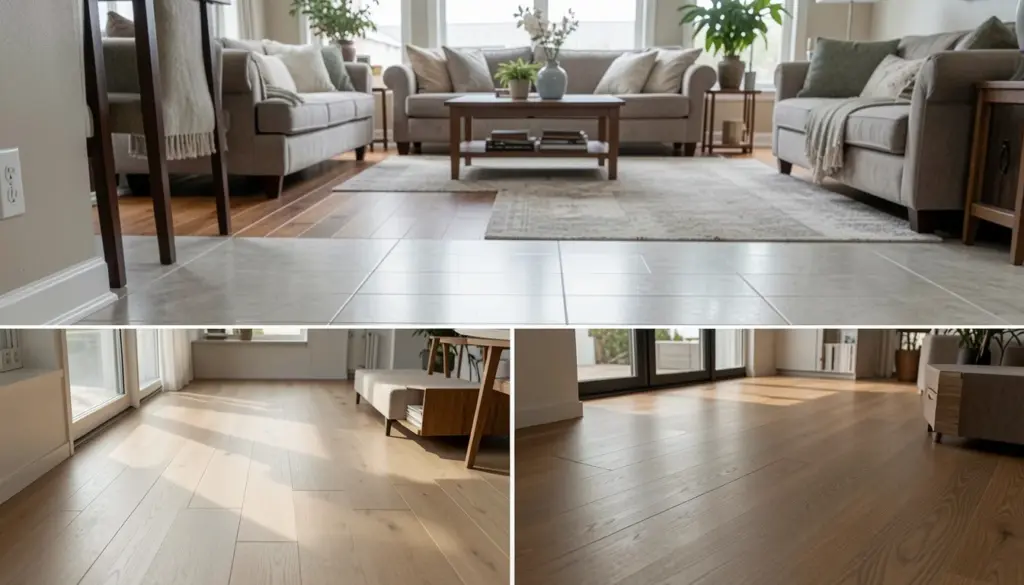
Choosing new flooring is one of the most consequential decisions in any home improvement project. The material you pick affects how a room looks, how long it holds up, what it costs to install, and how easy it is to maintain years down the line. Yet most guides treat each flooring type in isolation, leaving you to piece together comparisons on your own.
This guide takes a different approach. You’ll find a direct, room-by-room comparison of the four most common residential flooring materials — hardwood, tile, vinyl plank, and laminate — covering cost, durability, installation difficulty, and the specific conditions where each one makes sense. By the end, you’ll have a clear basis for making the right call for your home.
What Makes a Good Flooring Material?
Before comparing specific materials, it helps to understand what actually matters in a flooring decision. Four factors drive most choices.
Cost covers both materials and installation. A product with a lower per-square-foot price can still end up expensive if it requires professional installation or extensive subfloor prep. Always calculate the total installed cost, not just the material price.
Durability is measured by a flooring’s resistance to scratches, moisture, impact, and daily foot traffic. A material’s hardness rating (often measured on the Janka scale for wood products) gives a useful indication, but real-world performance also depends on finish quality and subfloor conditions.
Installation difficulty determines whether you can DIY the job or need to hire a contractor. This affects both cost and timeline. Some materials — particularly luxury vinyl plank with click-lock systems — are genuinely accessible to intermediate DIYers. Others, like natural stone tile, have a steep learning curve.
Maintenance requirements affect long-term ownership costs and effort. A material that requires annual refinishing or special cleaning products may cost less upfront but demand more over time.
Hardwood Flooring: Classic Appeal, Real Commitment
Hardwood remains the most sought-after flooring material for good reason. Solid hardwood — typically oak, maple, hickory, or walnut — delivers warmth and character that no manufactured product fully replicates. It also has a meaningful resale benefit: homes with genuine hardwood consistently attract buyer interest.
Cost: Solid hardwood runs between $6 and $12 per square foot for materials, with professional installation adding another $3–$5 per square foot. Engineered hardwood, which uses a thin veneer of real wood over a plywood core, typically runs $4–$9 per square foot installed and offers better dimensional stability in climates with humidity swings.
Durability: Species choice matters more than people expect. Red oak, the most common option, has a Janka hardness of 1,290 lbf — solid for most residential use but susceptible to denting in high-traffic areas. Hickory (1,820 lbf) and Brazilian cherry (2,350 lbf) hold up considerably better under heavy use. All hardwood scratches over time, which is why surface finish and periodic refinishing are part of ownership.
Moisture sensitivity is the defining limitation. Solid hardwood should not be installed in full bathrooms, laundry rooms, or below-grade basements. Engineered hardwood handles moderate moisture better, but neither type belongs in areas with a risk of standing water.
Best rooms: Living rooms, dining rooms, bedrooms, main-floor hallways. Avoid kitchens with heavy water exposure and all moisture-heavy spaces.
Tile Flooring: The Hardest-Working Surface in the House
Ceramic and porcelain tile are the most durable, moisture-proof flooring options available for residential use. Properly installed tile can last 50 years or more without any degradation in appearance or structure.
Cost: Ceramic tile is the more affordable option, running $1–$4 per square foot for basic materials. Porcelain tile — denser, harder, and more water-resistant — starts around $3 and can exceed $10 for premium large-format slabs. Installation is where tile costs climb. A skilled tile installer typically charges $5–$10 per square foot, and complex patterns (herringbone, hexagon, custom borders) push that higher. Total installed cost for a standard porcelain floor runs $8–$15 per square foot.
Durability: Tile is essentially indestructible under normal residential conditions. It resists scratches, moisture, staining, and heat. The weak point is grout, which absorbs stains and harbors mildew if not sealed and maintained properly. Sanded grout in wider joints needs sealing annually; epoxy grout eliminates that maintenance requirement but costs more to install.
Installation difficulty is the highest of any flooring category discussed here. Tile requires a rigid, level subfloor — any flex will crack the tile or grout over time. Cutting tile requires a wet saw, and working around obstacles demands careful planning. Most homeowners hire professionals for tile work, particularly in bathrooms.
Best rooms: Bathrooms, kitchens, laundry rooms, mudrooms, entryways. Tile’s hardness makes it less comfortable underfoot for living spaces where people stand for long periods — a radiant heating system underneath helps considerably.
Vinyl Plank Flooring: The Practical All-Rounder
Luxury vinyl plank (LVP) has become the fastest-growing flooring category because it solves problems that other materials can’t. It’s waterproof, relatively affordable, comfortable underfoot, and genuinely accessible for DIY installation.
Cost: LVP materials range from about $2 per square foot for entry-level products to $7–$8 for premium thick-core options. The wear layer — measured in mils — is the most important spec: residential use needs at least 12 mil, while high-traffic households benefit from 20 mil or more. DIY installation is realistic for most homeowners, bringing the total installed cost down to $3–$6 per square foot. Even with professional installation, vinyl plank typically lands below hardwood and tile.
Durability: Modern LVP is highly scratch-resistant and completely impervious to water — a genuine advantage over every wood-based product. It handles pet claws, dropped items, and spills without issue. The tradeoff is that it cannot be refinished: once the wear layer is gone, the floor must be replaced. A quality product with a 20-mil wear layer should last 20–25 years in a family home.
Comfort and sound are areas where vinyl plank improves meaningfully over tile. Most LVP includes an attached underlayment that provides cushioning and reduces hollow-sounding footsteps. In multi-story homes or over concrete slabs, a separate acoustic underlayment layer is worth adding.
Best rooms: Kitchens, bathrooms, basements, laundry rooms, children’s rooms, rental properties — essentially anywhere that benefits from waterproofing or sees heavy daily use. It works in living areas too, particularly in homes with pets or young children.
Laminate Flooring: Affordable Style With Important Limits
Laminate flooring uses a photographic image layer under a clear wear surface to mimic wood, stone, or tile. Modern high-definition printing makes laminate visually convincing, and it costs significantly less than what it imitates.
Cost: Laminate materials run $1–$4 per square foot, making it the most budget-friendly option on this list. Its click-lock installation system is DIY-friendly, keeping total installed costs in the $2–$5 range for most projects.
Durability: Laminate handles scratches reasonably well — the AC (abrasion class) rating system tells you how tough the surface is. AC3 is suitable for residential use; AC4 and AC5 perform better in higher-traffic environments. The key limitation is moisture. While some laminate products carry water-resistance claims, laminate is not waterproof. Water that seeps into seams can cause swelling, warping, and mold growth underneath. This limits where laminate should be used.
Feel underfoot: Laminate is notably harder and less forgiving than vinyl plank, and many products have a hollow sound when walked on that some homeowners find cheap-feeling. A quality underlayment helps, but the acoustic difference compared to real hardwood remains noticeable.
Best rooms: Bedrooms, living rooms, home offices — lower-traffic spaces in climate-controlled areas where moisture is not a concern. Avoid bathrooms, laundry rooms, and basements without excellent moisture control.
Side-by-Side Comparison by Key Factor
| Hardwood | Tile | Vinyl Plank | Laminate | |
|---|---|---|---|---|
| Avg. installed cost | $9–$17/sq ft | $8–$15/sq ft | $3–$6/sq ft | $2–$5/sq ft |
| Waterproof | No | Yes | Yes | No |
| Refinishable | Yes | No | No | No |
| DIY-friendly | Moderate | Difficult | Easy | Easy |
| Lifespan | 50–100 years | 50+ years | 15–25 years | 10–20 years |
| Best for | Living areas | Wet rooms | Any room | Dry bedrooms/offices |
How to Choose by Room
Kitchen: Tile or vinyl plank. Moisture, grease, and dropped items are constants. Hardwood and laminate are risky choices.
Bathroom: Tile is the traditional answer. LVP has become a strong alternative for full bathroom floors, especially in budget renovations or rentals.
Living room and dining room: Hardwood if the budget allows — it adds lasting value and warmth. LVP performs well here, too. Laminate is acceptable for lower-budget projects in dry climates.
Bedroom: Laminate and hardwood are both excellent. LVP works fine. Carpet is still common for comfort reasons, but hard flooring in bedrooms is increasingly popular.
Basement: LVP is the clear choice. It handles the moisture vapor that concrete slabs release and is comfortable underfoot. Tile is an option, but cold and hard without heating. Hardwood and laminate should generally be avoided below grade.
High-traffic entryways and mudrooms: Tile or LVP. Both handle dirt, moisture, and heavy foot traffic without deteriorating.
Installation: What Each Material Actually Requires
Hardwood installation requires precise fitting, nailing or gluing to the subfloor, and finishing if you choose unfinished planks. Pre-finished hardwood is more practical for most projects. The subfloor must be level and dry. Professional installation is strongly recommended.
Tile demands a rigid, crack-free substrate — often cement board over the subfloor in moisture-prone areas. Setting, grouting, and sealing each require different techniques. Most homeowners benefit from professional tile work, especially in bathrooms where waterproofing matters.
Vinyl plank with click-lock installation is the most accessible DIY flooring project. The planks float over the subfloor without adhesive, requiring only basic tools and patience. The subfloor should be level within 3/16 of an inch over 10 feet; high spots or dips need to be addressed beforehand.
Laminate installation is nearly identical to LVP — floating click-lock planks that most competent DIYers can handle. The main difference is the requirement for more careful moisture management around the perimeter and expansion gaps at all walls.
Final Thoughts
There is no single best flooring material. Each option earns its place based on where it goes, who lives in the home, and what the budget realistically supports.
Hardwood earns its premium in main living areas where aesthetic quality and long-term resale value justify the cost. Tile is the right call anywhere water is present — there’s no moisture-resistant substitute for properly installed porcelain. Vinyl plank offers the most flexibility, combining waterproofing with DIY-friendly installation across virtually every room in the house. Laminate makes sense for dry, lower-traffic spaces where budget is the primary constraint.
When planning your project, calculate total installed cost (not just material price), account for subfloor preparation, and match the product’s moisture rating to the room’s actual conditions. A higher upfront investment in the right material nearly always costs less than replacing the wrong one in a few years.
FAQs
Which flooring type adds the most home value?
Solid hardwood consistently delivers the strongest return in terms of perceived home value and buyer appeal. However, a well-installed tile or quality LVP floor in kitchens and bathrooms is often valued by buyers as much as hardwood in those specific areas.
Can I install new flooring over existing flooring?
Sometimes. LVP and laminate can float over existing tile or vinyl if the subfloor height allows. Tile-over-tile is possible if the existing layer is fully bonded. Hardwood over existing flooring adds height and requires careful planning around doors and transitions.
What’s the difference between waterproof and water-resistant flooring?
Water-resistant flooring handles minor spills and brief surface moisture without damage. Waterproof flooring — such as porcelain tile and high-quality LVP — can withstand prolonged exposure without structural damage. The distinction matters most in bathrooms, kitchens, and basements.
How thick should luxury vinyl plank be?
For residential use, a total thickness of 6mm or more provides adequate stability. 8mm and above is preferable for hiding minor subfloor imperfections. The wear layer thickness (at least 12 mil for residential use) matters separately from total product thickness.
Is laminate flooring the same as vinyl plank?
No. Both use click-lock installation and photographic surfaces, but they are fundamentally different products. Laminate uses a high-density fiberboard (HDF) core and is not waterproof. LVP uses a PVC-based core that is fully waterproof. The two products are not interchangeable in moisture-prone areas.
What flooring is best for homes with pets?
Tile and vinyl plank handle pet claws, accidents, and dander most effectively. Porcelain tile is essentially scratch-proof. LVP with a 20-mil wear layer resists claw marks well. Hardwood will show pet scratches over time, and laminate is vulnerable to pet urine seeping into seams.